
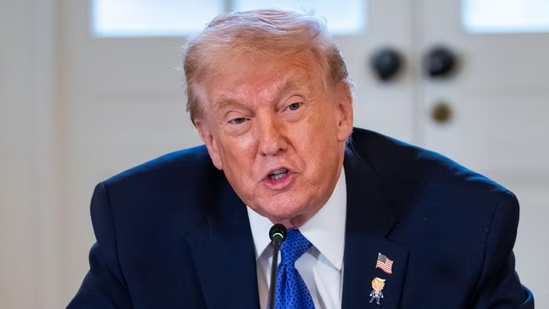
In the United States, there has been an ongoing controversy since the Supreme Court invalidated President Donald Trump’s procedure for implementing several types of tariffs. The Supreme Court, by a 6 to 3 ruling, ruled that Trump cannot claim the International Emergency Economic Powers Act as the basis for imposing “reciprocal” tariffs on a number of countries. The tariffs Trump imposed ranged between 10% and 50%.
Having been a little while since the ruling had taken place, Donald Trump reacted very strongly to it, calling it “un-American” and promising that his administration would impose import duties at a statutory maximum rate of 15%. He also instituted a 10% global tariff on all imported goods. He also criticised some members of the court and said he was unhappy with their ruling.
Europe and Australia React
The European Union voiced deep concerns. According to Bernd Lange (Chairman of the European Parliament’s Trade Committee), he was going to recommend otherwise and suspend the process for approving the Turnberry Agreement. The EU stated that the current situation is “pure chaos”. They urged the US to follow the terms of the 2018 trade agreement with Europe, reminding the US that in their view “a deal is a deal”.
There has been a reaction from the country of Australia regarding the newly introduced 15% tariff on imported goods. According to an official statement from the Government of Australia, there are a number of options available under the law that may be applied to benefit and safeguard their economy. With the continuing trade tensions between the countries involved, US Trade Representative Jamieson Greer stated that to date, no individual countries have terminated their trade agreements with the United States.
What It Means for India
The developments being closely monitored by India will determine whether or not the proposed reciprocal tariff of 18% that would apply to Indian goods will still be in effect following the Supreme Court ruling. Instead of remaining at 25%, the previous tariff rate may also be decreased to 15%.
According to India’s ministry of commerce. They are assessing the circumstances and their potential impact on the two countries’ bilateral relationship. As stated earlier, the US and India have expressed a continued commitment to negotiate a mutually agreeable interim trade agreement, taking into account changes in the law that recently occurred in both countries.