
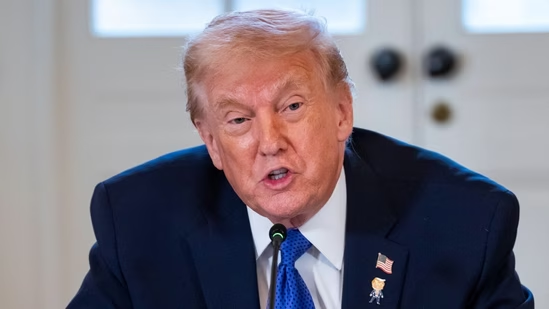
A new national survey shows that President Donald Trump is facing falling support, especially on immigration. Immigration has long been one of his strongest political issues. During his campaign and early months back in office, many supporters praised his strict border policies and deportation plans. However, the latest numbers suggest that public opinion may be shifting.
The findings come from a recent poll conducted by Reuters and Ipsos. The results show a noticeable drop in approval ratings compared to the start of his current term.
Immigration Approval Falls to 38%
According to the Reuters/Ipsos survey conducted between February 13 and 16, only 38% of Americans approve of President Trump’s handling of immigration. At the beginning of his term, that number stood at 50%. This means his approval rating on immigration has dropped by 12 percentage points.
The poll was based on a random sample of 1,117 adults from across the United States. The margin of error is plus or minus 3 percentage points. While there was also a slight drop in January, that earlier change was not considered statistically significant due to the margin of error. However, the current decline appears more noticeable.
Immigration has often been viewed as one of Trump’s strongest issues. His campaign promises focused heavily on border security, deportation efforts, and stricter enforcement. Many voters who supported him believed he would take strong action to reduce illegal immigration. For a long time, public opinion on immigration was more favorable toward him compared to other issues such as the economy.
Decline Among Male Voters
One of the most striking parts of the poll is the drop in approval among men. In early 2025, nearly half of male voters approved of Trump’s immigration policies. Now, that number has fallen to 41%.
This decline is important because male voters have traditionally been a strong support base for him. Losing ground among this group could signal broader concerns about how immigration policies are being carried out. Some observers believe that recent events may have influenced public opinion.
A few days before the poll, President Trump announced that his administration would end an immigration enforcement operation in Minnesota. The operation had drawn attention after federal agents shot and killed two U.S. citizens. The incident sparked criticism and raised questions about enforcement methods. While it is difficult to measure the direct impact of this event on polling numbers, it may have contributed to changing public views.
Overall Job Approval Remains Low
The same Reuters/Ipsos poll shows that Trump’s overall job approval rating is also at 38%. This number has not changed since the end of January. However, compared to the beginning of his term, when he had a 47% approval rating, it represents a clear decline.
Other polling averages show similar patterns. Data compiled by The New York Times and RealClearPolitics indicate that Trump has faced below-average approval ratings since returning to the White House.
According to RealClearPolitics data from early February, Trump received 42% positive evaluations and 55% negative evaluations. This results in a net approval rating of minus 13 points, which is one of the lowest net scores of his current term. A negative net approval means that more people disapprove of his performance than approve of it.
Comparing Immigration to Other Issues
While immigration once stood out as one of Trump’s strongest areas, the latest data suggests that support is weakening. In the past, even when his overall job approval was low, immigration remained a relative strength. Many voters believed he was more decisive and firm on border security than other political leaders.
Now, with immigration approval matching his overall approval rating at 38%, the issue no longer appears to give him a clear advantage. This shift may affect political strategy moving forward. If immigration support continues to decline, it could change how his administration communicates its policies and priorities.
What the Numbers Mean Going Forward
Polls represent public opinion at a specific moment in time. They can change depending on events, economic conditions, and political developments. The margin of error also reminds readers that small changes should be viewed carefully.
Still, a 12-point drop from 50% to 38% is significant. It suggests that some voters who once supported Trump’s immigration policies may now have concerns. Whether this decline continues or stabilizes will depend on future actions and public response.
For now, the latest survey paints a clear picture: President Donald Trump’s approval ratings on immigration and overall job performance have fallen compared to the start of his term. As new policies and events unfold, these numbers will likely remain closely watched by both supporters and critics across the country.