
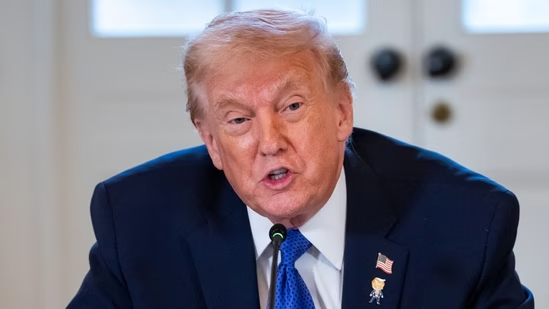
President Donald Trump has confirmed he will not invite two Democratic governors—Maryland’s Wes Moore and Colorado’s Jared Polis—to a White House meeting and dinner scheduled next week, despite claims from the National Governors Association (NGA) that all governors were invited. The announcement, made on Feb. 11 via Trump’s social media platform, Truth Social, has intensified tensions ahead of what is traditionally a bipartisan gathering.
Trump’s post emphasized his stance: “The invitations were sent to ALL Governors, other than two, who I feel are not worthy of being there.” His remarks underscored a selective approach that has left Democratic leaders frustrated and politically mobilized.
NGA’s Response and Historical Context
Earlier, the NGA had issued a statement praising Trump for agreeing to “welcome governors from all 55 states and territories to the White House,” irrespective of party affiliation. However, Trump disputed that characterization, asserting that NGA Chairman Kevin Stitt of Oklahoma “incorrectly stated my position” regarding the event.
Historically, White House dinners with governors have been bipartisan, offering a forum for leaders from both parties to discuss national issues. Trump’s selective invitations mark a notable departure from tradition, prompting a political stir and raising questions about the administration’s approach to cross-party engagement.
Democratic Governors Announce Boycott
The exclusion of Moore and Polis has triggered a significant response from Democratic governors. On Feb. 10, 18 Democratic governors announced they would boycott the White House events entirely. Among those joining the boycott are potential 2028 presidential contenders, including:
- Kentucky Gov. Andy Beshear, Democratic Governors Association chair
- Michigan Gov. Gretchen Whitmer, DGA vice chair
- California Gov. Gavin Newsom
- Illinois Gov. JB Pritzker
- Pennsylvania Gov. Josh Shapiro
This collective action signals the growing political divide and a broader critique of what Democrats view as an exclusionary approach by the White House.
Trump Explains His Reasons
Trump provided specific reasoning for disinviting the two governors. He cited Colorado’s continued imprisonment of Tina Peters, a former county clerk convicted for allegedly allowing unauthorized access to voting system data in a bid to support unsubstantiated 2020 election claims, as the rationale for excluding Gov. Polis.
Regarding Gov. Moore, Trump referred to him as “the foul-mouthed Governor of Maryland,” criticizing the ongoing crime issues in Baltimore and revisiting a past controversy regarding Moore’s Bronze Star military recognition. These personal and political judgments reflect Trump’s unconventional approach to invitations, emphasizing loyalty and perceived competence over tradition or protocol.
Reactions from the White House
White House Press Secretary Karoline Leavitt defended Trump’s prerogative, stating during a Feb. 10 briefing, “The president has the discretion to invite whomever he wants to the White House, and he welcomes all those who received an invitation to come. And if they don’t want to, that’s their loss.”
Leavitt’s statement underscores the administration’s position that attendance is optional and frames any absence as a choice by the governors, rather than a unilateral snub.
Political and Media Implications
Trump’s decision to exclude Moore and Polis has sparked widespread media coverage and debate about the partisan nature of presidential outreach. While some Republican governors remain engaged and supportive of Trump’s approach, the collective Democratic boycott highlights a deepening partisan divide and could have implications for the 2026 midterm cycle and the 2028 presidential race.
By publicly singling out governors for exclusion, Trump has framed the gathering as a selective showcase rather than a bipartisan forum. Analysts suggest that this approach may bolster support among loyalist constituents while alienating moderates and Democrats, intensifying political polarization.
What’s Next for the White House Dinner
The meeting and dinner are scheduled to coincide with the NGA’s annual winter meeting in Washington, DC, from Feb. 19 to 21. With multiple Democratic governors declining participation, the event may largely feature Republican leaders, raising questions about the efficacy of cross-party dialogue at the federal level.
Trump, meanwhile, continues to emphasize that he has invited “all other Governors, Democrat and Republican,” including prominent Democratic leaders such as Govs. Newsom and Pritzker, signaling that some Democrats could still choose to attend. Whether they do so remains uncertain, as the political stakes around participation are high.
Conclusion
Trump’s insistence on excluding Governors Moore and Polis marks a significant departure from the traditional bipartisan nature of White House gatherings. The resulting Democratic boycott and public dispute with the NGA highlight the ongoing partisan tensions in American politics. As the White House dinner approaches, the focus will remain on which governors ultimately attend, how the administration navigates criticism, and what this signals for political engagement across party lines.