
Trump Announces Oil Tanker Blockade on Venezuela

Donald Trump, President of the United States, has imposed a strict embargo (or blockade) against oil tankers subject to US Treasury Department sanctions from both bringing oil into and taking oil away from Venezuela. With this order, former President Trump hopes to increase pressure on the Venezuelan Government of Nicolás Maduro by eliminating the country’s primary revenue stream through oil exports. This decision has led to significant uncertainty in the global financial markets and has raised critical legal and political considerations. Reason Behind the Blockade Decision According to Trump, the rationale for the decision is based upon the Venezuelan government being involved in “terrorism”, “drug trafficking”, “human trafficking” and “theft of U.S. property”, all of which he considers acts of terrorism against the United States. Also, he indicated that Venezuela’s leadership would be treated as a foreign terrorist organisation by the U.S. That determination, stated Trump, gives the United States the ability to impose stricter sanctions on oil shipments associated with Venezuela. How the Blockade May Be Enforced The actual details of the blockade remain uncertain. Military officials in the United States have not publicly confirmed which branch of the military (the Coast Guard or the Navy) will actually carry out the execution of the blockade, but numerous reports suggest that thousands of Army and Air Force soldiers, along with several warships (including an aircraft carrier), have been moved to the area of the potential blockade. This suggests that there may be a significant military force in place to provide assistance for the enforcement of the blockade order. Rejection by the Venezuelan Government Venezuelan authorities have responded strongly to the recent announcement of a blockade on their country, calling it a “grotesque threat” and accusing the United States of attempting to take control of their petroleum resources. President Maduro also stated that the U.S. seeks to diminish Venezuela’s position, replace Maduro with a friendlier leader, and thus facilitate their takeover of the oil industry. Economic Impact of the Blockade The announcement of the blockade has led to an increase in global oil prices. Oil markets in Asia saw prices increase by more than 1% due to the fear that if U.S. tankers were to be stopped or seized, significant quantities of oil (approximately 1 million barrels per day) would be eliminated from the market, thereby greatly affecting the price of oil globally. Legal and Political Issues Related to the Blockade Legal professionals have questioned whether or not blockades are even lawful actions under international law. Legal experts suggest that blockades are inherently acts of war and can only be utilised under specified strict conditions. Additionally, many lawmakers in the U.S. Congress, including Rep. Joaquin Castro (D-Texas), have expressed concern regarding the legality of this act and have commented that it does not represent the wishes of the American people. Current Exports Decline and Sanctions in Place Even prior to the announcement of the latest U.S. actions against Venezuela, the country was already facing a series of heavy energy-related sanctions by U.S. authorities. Many tankers that transport Venezuelan oil products have also been sanctioned, resulting in traders creating shadow fleets that carry Venezuelan oil. After the recent seizure of a sanctioned tanker by U.S. authorities, at least two oil-laden ships continued to remain within the Venezuelan territorial waters in order to avoid seizure by U.S. authorities. Cyber-attacks that recently targeted PDVSA (a state-owned oil company in Venezuela) have decreased the amount of crude oil being exported out of the country. Human and Economic Impact of Current Conditions Long-term consequences would likely be severe if a full-blown blockade were to occur. The increase in crude oil prices would likely increase inflation worldwide because other countries rely heavily on imported crude oil. Additionally, the absence of crude oil sales from Venezuela will likely Uncertain Future Ahead While the announcement has shaken markets and politics, many questions remain unanswered. The world is watching closely to see how the blockade will be enforced and whether it will expand further. The situation could reshape energy markets and diplomatic relations in the coming months. For more in-depth global business news, geopolitical insights, and expert analysis on how international events impact markets, visit https://thebusinesstycoonmagazine.com/ and stay informed with trusted business journalism.
Google Launches Gemini 3: Advanced AI Model with Agent Features and Generative Interfaces

Google has officially launched Gemini 3, its latest artificial intelligence (AI) model designed to set new industry standards in reasoning, multimodal understanding, and user interaction. This SEO-optimized article explores the key features of Gemini 3, including its generative interfaces, agent capabilities, and integrations that aim to revolutionize digital experiences for users and developers alike. Gemini 3 Overview: Next-Generation AI Gemini 3 stands out as Google’s most powerful AI model to date. It features enhanced state-of-the-art reasoning and can process complex, multi-stage tasks across vast subject areas—from science to content creation. The model is engineered to understand context and nuance, making its responses more helpful, concise, and accurate for users. By unveiling Gemini 3 within its dedicated Gemini app, Google allows users to immediately experience the improved intelligence and usability, marking a significant step forward in delivering cutting-edge AI technologies directly to consumers. Generative Interfaces: Dynamic and Visual Responses One of Gemini 3’s most innovative advancements is the introduction of generative interfaces. This technology enables the model to automatically create the most suitable visual and interactive response for a user’s query, rather than relying on plain text. Key features include: This dynamic user interface adapts on-the-fly, enhancing clarity and actionable information, making it easier to understand and interact with complex data. Advanced Agent Capabilities Gemini 3 introduces powerful agent features, positioning it at the forefront of AI automation: These agentic qualities make Gemini 3 a truly generalist AI, capable of not only answering questions but taking meaningful actions on behalf of its users. Developer Platform: Introducing Google Antigravity To further accelerate innovation, Google has launched the Antigravity platform, purpose-built for agent-first development: This environment streamlines development and enhances productivity for engineers harnessing Gemini 3’s agentic power. Shopping Integration with Google’s Shopping Graph Gemini 3 integration expands into e-commerce with direct access to Google’s vast Shopping Graph: This integration brings AI-driven product discovery and e-commerce assistance directly to end users, further blurring the lines between search, recommendations, and shopping. Enhanced Reasoning and the Deep Think Mode Google’s commitment to robust, safe AI capabilities is clear in the introduction of Gemini 3’s Deep Think mode: Availability and User Access For the first time, Google deploys its most advanced AI model simultaneously for general users and developers. Gemini 3 is now built into the Gemini app and available in AI Mode for Google Search, with premium features accessible to AI Ultra members. This approach democratizes state-of-the-art AI, accelerating adoption and exploration. Conclusion: A New Standard for Interactive AI Gemini 3 represents a leap forward for Google and the broader AI landscape. With generative interfaces, autonomous agent capabilities, a developer-focused platform, and seamless shopping integration, Gemini 3 positions itself as the foundational engine for intelligent digital interactions across consumer and professional applications. As AI-driven experiences become increasingly visual and interactive, Gemini 3 sets the benchmark for usability, versatility, and transformative technology in 2025 and beyond. For more insights, subscribe The Business Tycoon
Michael Burry Closes Scion Fund, Eyes Next Investment Move

Legendary investor Michael Burry, acclaimed for predicting the 2008 financial crisis and immortalized in “The Big Short,” has officially shuttered his hedge fund, Scion Asset Management. This move ends a notable chapter in value investing, sparking speculation across financial circles about the motivations behind his decision and what lies ahead. Scion Asset Management: An Era Ends Regulatory filings as of November 2025 confirm Scion’s deregistration with the U.S. Securities and Exchange Commission, ending its status as a registered investment adviser. At its peak, the fund managed about $154 million in assets, and Burry’s social media revealed his intention to liquidate holdings and return investor capital before year’s end. The decision was communicated through a heartfelt letter, reflecting both gratitude and apology, and acknowledging that his “estimation of value in securities is not now, and has not been for some time, in sync with the markets”. Disillusionment with Market Valuations Burry’s exit is rooted in growing skepticism about current market dynamics, particularly within the technology and artificial intelligence sectors. He has frequently voiced concerns about inflated valuations, accusing major tech giants of accounting practices that obscure the true profitability of their AI investments. Burry describes today’s market as an “illusion of endless growth,” warning that speculative enthusiasm has overtaken economic fundamentals. Dramatic Moves Against AI Giants Coinciding with Scion’s closure, Burry disclosed bearish positions against leading AI stocks, notably Nvidia and Palantir. This contrarian play underscores his conviction that the sector is in the midst of a speculative bubble, with hype driving valuations far above intrinsic worth. The closure of Scion, therefore, is less about withdrawal than a principled stand—an assertion that disciplined value investing is incompatible with today’s overconfident, bubble-prone market. Echoes of 2008: Historical Parallels This latest move from Burry bears a striking resemblance to his 2008 exit, when he closed Scion Capital after profiting from his infamous bet against the housing market. He invested heavily in credit default swaps—a bold wager that paid off as the subprime mortgage crisis unfolded. His reputation as a financial contrarian was solidified, and his actions again seem to reflect cautious conviction before a possible inflection point in financial markets. Investor Reaction and Wider Market Sentiment Wall Street has taken note, viewing Burry’s fund closure as a possible early warning of increased market volatility. Some analysts argue that Burry’s disenchantment signals underlying risks and a possible correction, especially in segments fueled by rampant speculation. While some believe his withdrawal is temporary, others see it as a barometer of deeper structural changes ahead. What’s Next for Michael Burry? Although Burry hasn’t issued a formal public statement about his future, his social media hints at “much better things” beyond Scion. Speculation suggests he may explore private investments, less regulated ventures, or alternative asset strategies. Despite stepping away from fund management, Burry’s contrarian instincts and commitment to principle remain, ensuring his next chapter will be closely watched by investors and analysts alike. Legacy of Integrity Burry’s move reflects a steadfast devotion to value-based investing, even when it means stepping away from markets that no longer align with his philosophy. His decision to return capital and advocate caution underscores his reputation as a principled contrarian—someone willing to act against prevailing sentiment when warranted by market conditions. Conclusion Michael Burry’s closure of Scion Asset Management is both an end and a potential new beginning. Driven by disappointment in speculative market dynamics, his exit signals a call for renewed discipline and integrity in investing. As he hints at entering a new chapter, market watchers and fellow investors will be paying close attention, seeking insights from one of finance’s most unconventional minds. For more insights, subscribe The Business Tycoon
Foxconn Teases Major OpenAI Partnership, AI Servers Surpass iPhones as Revenue Driver
Foxconn, a global leader in electronics manufacturing, is undergoing a significant transformation as artificial intelligence becomes its primary growth engine, signaling a dynamic shift from traditional consumer electronics toward AI infrastructure and deep tech collaborations. During its recent third-quarter earnings call, Foxconn, also known as Hon Hai Technology Group, announced it would unveil details of a partnership with OpenAI at its upcoming tech day in Taipei, setting industry expectations for a groundbreaking reveal between two technology giants. The news comes on the heels of Foxconn’s robust financial results, with a notable year-over-year profit increase driven largely by surging demand for AI servers. This move positions Foxconn at the center of the global AI revolution and introduces a new growth narrative for the company. Earnings Reveal AI as New Growth Engine Foxconn reported stellar third-quarter earnings: net profit rose 17% year-over-year to NT$57.67 billion (about $1.89 billion), with revenue up 11% to NT$2.06 trillion. Chairman Young Liu attributed this success especially to the company’s cloud and networking division, which now includes AI server manufacturing. Notably, this segment has outperformed the consumer electronics unit, including iPhone assembly, for two consecutive quarters. This shift marks a decisive reclassification for Foxconn, aligning its name not just with electronics assembly, but with high-value AI infrastructure and supply chain leadership. AI Servers Overtake iPhones as Revenue Leader For the second straight quarter, Foxconn’s AI server sales outpaced its signature iPhone assembly business, a milestone that represents a dramatic pivot from the company’s 2021 profile, when consumer electronics accounted for over half its revenue. With this transition, Foxconn reduces dependence on the volatile smartphone market and leverages the stability and growth of AI-driven infrastructure. Foxconn and OpenAI: Anticipated Collaboration The market is eagerly anticipating Foxconn’s announcement of its partnership with OpenAI, the company famously behind ChatGPT. Although details remain under wraps until the forthcoming tech day, industry analysts speculate that the collaboration will focus on AI hardware, advanced model integration, and potentially smart manufacturing solutions. Strategic Implications and Sector Impact Foxconn’s proactive pivot is a transformational move for the tech sector, attracting capital from investors interested in AI stocks and future-ready portfolios. The manufacturer’s diversification strategy expands its coverage from consumer devices into data center, networking, and cloud hardware for major AI platforms, reducing its exposure to smartphone market volatility. Forward-Looking Statements and Risks While Foxconn’s leadership expresses high optimism about the AI market through 2026, they emphasize a cautious monitoring of geopolitical pressures and currency risks, particularly as global supply chains realign. The company’s expansion into the United States and other global markets also serves to hedge against external shocks. Conclusion: Foxconn’s AI-Fueled Future Foxconn’s current trajectory marks it as a major infrastructure node for the next generation of computing, transitioning from pure contract manufacturing to strategic partnerships that will shape the future of AI. The upcoming tech day and partnership reveal with OpenAI will likely determine the scope and scale of Foxconn’s influence in the rapidly growing AI sector.
China’s K Visa: Attracting Global Tech Talent Amid US Restrictions

In October 2025, China officially launched the K Visa, a new immigration pathway designed to draw high-caliber foreign professionals in science, technology, engineering, and mathematics (STEM) fields. This policy signals Beijing’s intent to close its talent gap, compete globally, and reshape the flow of international tech experts. Unlike previous visa categories, the K Visa allows foreign nationals to apply without a confirmed job offer, providing flexibility and responding to recent shifts in global immigration trends. Why the K Visa Now? Responding to US Immigration Changes The timing of the K Visa roll-out coincides with significant changes to US immigration policies. Recent US decisions, such as imposing a $100,000 fee on new H-1B applications, have made it increasingly challenging for skilled professionals to secure permission to work in the United States. This has prompted many potential immigrants, especially from India and Southeast Asia, to look elsewhere. By introducing the K Visa, China aims to fill the void and attract global talent that may otherwise have sought opportunities in North America. Experts note that Beijing sees the tightening US approach as an opportunity. “Beijing perceives the tightening of immigration policies in the US as an opportunity to position itself globally as welcoming foreign talent and investment more broadly,” said one industry analyst. Key Features and Requirements of the K Visa The K Visa marks a significant evolution in China’s immigration strategy for several reasons: This visa supplements existing pathways, increasing China’s appeal for researchers, scientists, and highly educated workers worldwide. China Versus U.S.: K Visa Compared to H-1B Aspect China’s K Visa US H-1B Visa Job Offer Requirement None Mandatory Fee Not specified $100,000 for new applicants Target Groups STEM graduates, researchers, professionals Specialty occupations Policy Direction More inclusive and open More restrictive and expensive China’s more relaxed approach contrasts markedly with recent US trends, making it a potentially attractive alternative for mobile global talent. Potential Benefits for China’s Innovation Drive Chinese officials and media have celebrated the K Visa as a strategic step toward addressing the country’s technology talent shortage. By luring both international experts and returning overseas Chinese, Beijing hopes to reverse decades of “brain drain” and accelerate domestic advancements in frontier sectors like AI and robotics. Expanded visa-free entry for short stays reinforces this openness; nearly 16 million foreigners visited China visa-free in the first eight months of 2025 alone. This policy also encourages international partnerships, knowledge transfer, and cross-border innovation, further positioning China as a global scientific and technological powerhouse. Domestic Backlash and Structural Barriers Despite the K Visa’s potential, the program faces significant hurdles: Analysts caution that unless China tackles these systemic issues and offers greater transparency and support, the K Visa alone might not be enough to lure the best and brightest away from competing hubs like the UK or the European Union. The Global Outlook: Will the K Visa Reshape Tech Migration? The launch of the K Visa is an ambitious step in global talent competition, but its ultimate effect will depend on more than visa rules alone. Experts suggest that while China could attract more applicants amid US restrictions, most would-be emigrants might still favor other Western economies unless China makes broader institutional reforms. Nevertheless, by modernizing its approach to skilled immigration, China has taken a clear stand: it wants to be seen as a destination of choice for the next generation of science and technology leaders. As global migration trends shift, the success of the K Visa will serve as a barometer for China’s standing in the innovation race. Conclusion China’s K Visa program represents a pivotal policy change in global tech talent recruitment. By loosening requirements and capitalizing on US visa tightening, Beijing aims to attract a greater share of the world’s top scientists and engineers. While challenges remain—especially in labor integration and social acceptance—the move underscores China’s ambitions to become a leading global center for science and innovation. For more insights, subscribe The Business Tycoon
Tech Stock Sell-Off: Are AI Bubble Fears Signaling a Market Correction?

Tech Giants Rocked by AI Bubble Fears: Global Market Faces Uncertainty Recent days have witnessed a dramatic downturn in global stock markets, driven largely by mounting concerns around an “AI bubble” that threatens the stability of the technology sector and the wider financial landscape. With tech valuations skyrocketing in recent years, and key investors betting against some of the biggest companies in the industry, market watchers are questioning whether current price levels are sustainable. The Trigger: Fears and Short Bets Shake Major Indexes Early November saw renewed volatility across the Nasdaq, S&P 500, and key Asian indices such as Japan’s Nikkei 225 and South Korea’s Kospi. Tech titans like Apple, Amazon, Microsoft, and Alphabet all posted substantial losses, while the semiconductor sector—integral to AI infrastructure—witnessed a staggering $500 billion drop in market value. These shocks were amplified by notable short positions from prominent investors like Michael Burry, who gained international fame for predicting the 2008 financial crisis. Burry’s decision to take a massive short position against leading AI stocks Palantir and Nvidia injected fresh anxiety into the market. Statements from market insiders, including hedge fund chiefs and Wall Street executives, have further inflamed speculation that an overheated AI sector could lead to a broader correction. Valuations Detach from Fundamentals One of the most significant warning signs is the apparent disconnect between sky-high valuations of AI and tech firms and their actual economic resilience. Palantir, for example, was recently valued at over 300 times its projected 2025 earnings, and the S&P 500’s forward price-to-earnings ratio now mirrors levels seen before the dot-com crash. While the promise of AI-driven innovation continues to attract huge inflows of capital, a growing body of analysts caution that much of this investment is based on speculative momentum, rather than demonstrated profitability. The AI Investment Frenzy and Mixed Results The world’s top technology companies have collectively invested over $400 billion in AI infrastructure this year alone. However, a study by MIT found only 5% of more than 300 corporate AI projects have delivered measurable benefits, with most stalling in pilot phases due to integration and scalability issues. While cloud computing giants like Amazon Web Services, Microsoft Azure, and Google Cloud are seeing revenue growth thanks to AI processing demand, their profit margins are under increasing strain due to surging infrastructure costs. This mismatch between investment and profit has raised echoes of previous speculative bubbles. Interconnected “circular” deals—where companies invest in each other’s AI projects—are drawing comparisons to the late 1990s, when similar patterns contributed to the dot-com bust. Global Implications: Ripple Effects Beyond Big Tech The risk-off sentiment has not only hammered tech stocks in the U.S. but also sent shockwaves through Asian and European markets. The Nikkei 225 posted its biggest drop in seven months, reflecting the global nature of current fears. Even digital assets like Bitcoin briefly plunged as investors sought safer havens amid uncertainty. Meanwhile, “Magnificent 7” stocks—including Apple, Amazon, Microsoft, Alphabet, Meta, Tesla, and Nvidia—have accounted for the overwhelming majority of S&P 500 gains in recent months, deepening worries about a narrow and vulnerable rally. CEO and Regulator Warnings Raise the Alarm Financial leaders at Goldman Sachs and Morgan Stanley have sounded the alarm at investment summits, warning of potential 10–20% corrections in tech-heavy indices if sentiment doesn’t turn soon. The sharpness of recent sell-offs underscores concerns that any slowdown or negative news could quickly cascade, erasing billions more in value and challenging the optimism surrounding artificial intelligence’s market impact. Silicon Valley’s Financial “Arms Race” Vast sums are being spent on new data centers and next-generation AI chips, leaving only the largest companies able to compete at the highest level. This “financial arms race” is creating tough barriers for smaller firms, setting the stage for possible market consolidation and shakeouts if the bubble bursts. Reports reveal that up to 95% of generative AI initiatives fail to achieve notable revenue growth, spotlighting the risks tied to speculative capital infusions and raising questions about the most likely survivors in a potential downturn. Lessons from History: Is a Market Correction Imminent? The present environment bears striking similarities to past speculative mania, notably the dot-com bubble, where a rush of investor optimism was eventually met with harsh financial reality. As tech stocks correct and warnings multiply, experts stress the importance of disciplined investment strategies and a renewed focus on genuine, long-term profitability in the AI sector. Conclusion: Navigating an Uncertain Future While artificial intelligence continues to inspire massive investments and transform business strategies, current market turbulence is a stark reminder of the dangers of runaway valuations. As scrutiny intensifies and short interest rises, investors are urged to distinguish real innovation from hype and focus on fundamentals to weather the possible storm ahead.
Adobe MAX 2025: Firefly Foundry Redefines Enterprise AI Creativity

Adobe MAX 2025 Ushers in a New Era for Enterprise AI Creativity Adobe’s annual MAX conference in Los Angeles captured global attention in late October 2025, unveiling a bold new platform strategy designed to transform creative business workflows at scale. Center-stage was the introduction of Firefly Foundry, a fully managed AI service tailored for large enterprises seeking proprietary, on-brand content generation, coupled with strategic partner integrations, enhanced pricing models, and the expansion of Adobe’s Content Authenticity Initiative. Firefly Foundry: Enterprise AI Model Creation Firefly Foundry is Adobe’s answer to the growing demand for customized, secure AI solutions in the enterprise market. Unlike previous approaches, Firefly Foundry allows organizations to collaborate directly with Adobe experts, including PhDs and advanced AI engineers, to build multi-year, deeply tuned generative AI models based entirely on proprietary brand assets and guidelines. The Foundry empowers brands to scale content production, streamline marketing workflows, and extend creative reach, all while maintaining rigorous controls over brand voice and data security. Seamless Platform Integration & Expanding Partner Ecosystem Adobe’s vision for Firefly Foundry extends across its powerful creative ecosystem—including GenStudio, Creative Cloud, and Express—enabling businesses to deploy AI assets efficiently and safely. The company also announced integrations with leading AI providers like Google, OpenAI, ElevenLabs, and Runway, further enriching the Firefly platform’s capabilities. Adobe’s “commercially safe AI vendor” positioning is reinforced by exclusive use of licensed and public domain data for model training, critical as content standards and regulations tighten globally. Consumption-Based Pricing Redefines Enterprise Flexibility A major shift for enterprise customers is Adobe’s adoption of a consumption-based pricing structure. Teams now purchase “generative credits” that act as currency across AI features in Creative Cloud, with each subscription offering a baseline amount: Content Authenticity Advances and Compliance Initiatives Recognizing rising regulatory and ethical standards around AI-generated content, Adobe expanded its Content Authenticity Initiative at Adobe MAX 2025. Over 50 products now participate in the conformance program, focused on content provenance, creator attribution, and compliance with regulations like the EU AI Act and California AI transparency laws. Strategic Impact and Industry Leadership Adobe’s enterprise-focused announcements at Adobe MAX 2025 reflect a decisive pivot toward comprehensive, scalable creative solutions. With Firefly Foundry, robust partner integrations, and a flexible pricing model, Adobe aims to help organizations overcome production bottlenecks and fuel innovation at every stage of content creation. As AI adoption accelerates, Adobe is setting itself apart through responsible innovation, strategic partnerships, and a platform designed to serve the entire spectrum of creative needs in the enterprise market. For more insights, subscribe The Business Tycoon
India Win Historic First ICC Women’s World Cup 2025 Title

India’s Triumph: A New Era in Women’s Cricket India’s women’s cricket team made history by winning their maiden ICC Women’s Cricket World Cup title, overcoming South Africa by 52 runs in a landmark final at Navi Mumbai’s DY Patil Stadium. After decades of near misses and heartbreaks, India finally lifted the trophy in front of an ecstatic home crowd, marking a new chapter for women’s cricket in the country and the continent. Shafali Verma’s Explosive Batting Sets the Platform India were asked to bat first and made the most of their opportunity from the outset. Shafali Verma, the young phenom, led the charge with a blistering 87 off 78 deliveries, striking seven boundaries and two sixes. Her aggressive intent not only set the tone for the innings but also placed significant pressure on South Africa’s bowlers throughout the powerplay. Opening partner Smriti Mandhana complemented Verma with a fluent display, helping India race past the 50-run mark in under 10 overs. The duo’s partnership weathered a two-hour rain interruption and kept the home fans hopeful for a formidable total. Deepti Sharma: The All-Round Match Winner Deepti Sharma emerged as India’s star, delivering both with bat and ball when it mattered most. After contributing a crucial 58 runs in the middle order, Sharma’s exceptional bowling spell shattered South Africa’s hopes. Her figures of 5 for 39 turned the tide, making Sharma the first bowler to claim a five-wicket haul in a Women’s World Cup final. Sharma’s impact was not limited to wickets—she broke partnerships at critical junctures, most notably dismissing South African captain Laura Wolvaardt, whose century had kept her team alive in the chase. Sharma’s all-round heroics earned her widespread acclaim and cemented India’s path to victory. South Africa’s Fight Through Laura Wolvaardt South Africa’s response was led by their captain Laura Wolvaardt, who crafted a brilliant 101 off 98 balls. Despite her resolve, South Africa struggled for consistency, losing wickets at regular intervals—especially after Sharma’s breakthroughs. The rest of the lineup could not support their captain, falling short by 52 runs as they finished their innings at 246. The Influence of Coach Amol Mazumdar This historic achievement was shaped behind the scenes by head coach Amol Mazumdar, whose leadership injected new belief and discipline after a period of instability. Known for his vast domestic experience, Mazumdar redefined India’s approach with tactical acumen and motivating team talks—most notably after a close defeat to England in the group stage. The turnaround was seen in India’s spirited comeback and record chase in the semifinals, ultimately culminating in the final win. Prize Money and the Significance of Victory India’s triumph wasn’t just about sporting glory—it also came with record-breaking financial rewards. The team received a staggering USD 4.48 million (approximately Rs 39 crore), representing the highest prize purse in Women’s World Cup history and a testament to the growth of women’s cricket in India and globally. South Africa, as runners-up, also secured a significant reward, reflecting the high stakes and rising recognition in international women’s cricket. Ecstatic Celebrations and Emotional Moments The final whistle unleashed spontaneous celebrations—tears, hugs, and slogans filling the stadium. Harmanpreet Kaur lifted the trophy surrounded by smiling teammates, fans waving the national flag, and the world acknowledging India’s new position at the pinnacle of women’s cricket. Impact on Women’s Cricket in India India’s triumph in the 2025 Women’s World Cup sets in motion a new era for the sport in the country. Boosted by large viewership, media coverage, and a dramatic increase in financial support, women’s cricket has finally captured the nation’s imagination. The victory is expected to inspire a new generation of cricketers and amplify the demand for more grassroots development and professional opportunities. Key Highlights from India’s World Cup Campaign Conclusion India’s victory in the ICC Women’s World Cup 2025 stands as a watershed moment in the nation’s sporting history. The remarkable all-round display by Shafali Verma and Deepti Sharma, guided by coach Amol Mazumdar, consummated years of progress and determination. With new stars, robust support, and rising investment, the future of women’s cricket in India looks brighter than ever
BlackRock $500 Million Fraud: Telecom Scandal Explained

BlackRock Telecom Fraud: $500 Million Scandal Shakes Private Credit Market In October 2025, BlackRock’s private credit division was hit by a devastating fraud, resulting in a loss of more than $500 million. The deception was orchestrated by Indian businessman Bankim Brahmbhatt through his telecom-financing firm, Carriox Capital. Using fabricated documents and sophisticated digital tactics, Brahmbhatt created the appearance of financing legitimate receivables for prominent telecom companies, duping global lenders for years. How the Massive Deception Scheme Unfolded Carriox Capital claimed to fund telecom receivables for industry giants like T-Mobile, Telstra, and Telecom Italia Sparkle. However, investigations later revealed that many of these contracts and invoices were entirely forged. Brahmbhatt went to extreme lengths to make the scheme appear authentic, including building fake email domains that closely resembled real telecom organizations. These domains enabled his staff to send fraudulent confirmations and correspondence to unsuspecting lenders. By using these falsified receivables as collateral, Brahmbhatt was able to secure hundreds of millions in loans from leading financial institutions, notably BlackRock and French bank BNP Paribas. The scheme relied on circular transactions and fictitious payments, masking the fraud from auditors for years. The Collapse: Discovery and Investigation The fraudulent operation began to unravel when due diligence checks detected discrepancies in Carriox’s paperwork and communications. Suspicious email addresses and inconsistencies in supposed customer correspondence drew attention, prompting lenders to launch a thorough investigation. Once the fraud was confirmed, BlackRock and other impacted lenders swiftly pursued legal action, demanding repayment of the $500 million lost to the scam. Further scrutiny revealed the depth of the conspiracy: every customer email provided by Brahmbhatt’s companies over the past two years was forged, with some falsified contracts stretching back to 2018. Lenders also claim Brahmbhatt secretly moved pledged assets to offshore accounts in India and Mauritius, making recovery even more difficult. Executive’s Disappearance and Bankruptcy Filings As the investigation reached its peak, Brahmbhatt vanished from public view. When BlackRock’s team visited his New York office, they found it deserted. Shortly after a major news report exposed the scheme, Brahmbhatt deleted his social media accounts and became untraceable. Industry insiders believe he fled to India, leaving his businesses and lenders in turmoil. On August 12, 2025, Brahmbhatt declared personal bankruptcy, coinciding with his companies seeking Chapter 11 protection. Associated entities, Carriox Capital II and BB Capital SPV, also entered bankruptcy proceedings, complicating the legal battle for lenders. Impact on Global Lending and Private Credit Market The scandal has triggered alarm throughout the private credit industry, especially in asset-backed lending where revenue streams serve as collateral. BlackRock’s loss, while significant, represents only a fraction of its $179 billion private credit portfolio, but it underscores the risks tied to rapid expansion and reliance on borrower-supplied documents. BNP Paribas, which financed nearly half the disputed loans, increased its loan loss provisions by €190 million in its recent financial disclosures. The bank declined to specify whether this relates directly to Carriox, but industry observers believe the connection is clear. Telecom fraud schemes like this expose how digital manipulation and well-planned counterfeiting can bypass controls, especially when verification depends heavily on borrower-provided information. Cases such as Carriox highlight the urgent need for more robust due diligence, better digital verification tools, and greater industry collaboration to detect and prevent large-scale financial deception. Lessons for the Industry: Preventing Telecom Fraud The telecom and lending industries must take away crucial lessons from this event. BlackRock Telecom fraud comes in many forms, from fabricated invoices and identity theft to more intricate schemes exploiting digital channels and email spoofing. Prevention strategies now include: As fraudsters adapt new technologies to their schemes, companies must stay ahead of emerging trends by constantly updating their fraud detection and response strategies. What’s Next for BlackRock and Lenders? Legal proceedings against Brahmbhatt and his companies are ongoing. Recovery of the stolen funds will be challenging, given the complexity of the offshore asset transfers and bankruptcy filings. Lenders are expected to tighten controls, implement advanced verification processes, and commit resources to minimizing their exposure to similar risks in the future. Meanwhile, this case stands as a stark warning: rapid growth in private credit and telecom finance brings new opportunities—and new dangers. The BlackRock fraud scandal will likely spur long-term changes across financial institutions and the telecom sector, with enhanced vigilance and technological upgrades at the forefront of risk management. For more insights, subscribe The Business Tycoon
Digital Car Key Technology: Samsung Partners with Mahindra for Next-Gen Electric SUVs
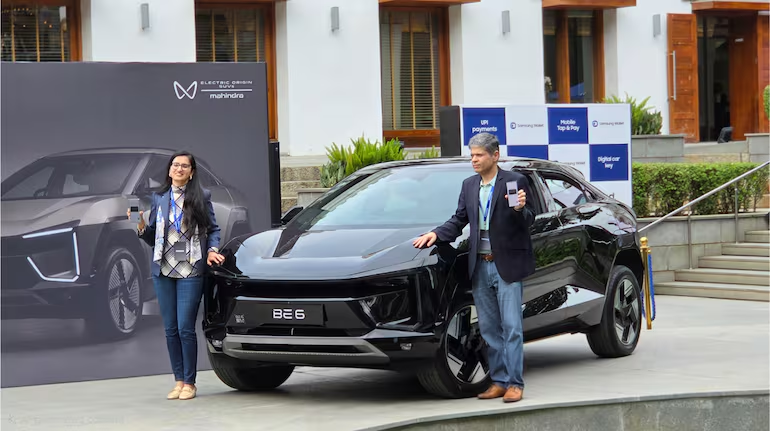
Samsung’s rollout of Digital Car Key support for Mahindra Electric Origin SUVs is set to redefine how Indian consumers approach vehicle security and convenience. Powered by Samsung Wallet, this integration allows users to lock, unlock, and start select Mahindra electric SUVs directly from eligible Samsung Galaxy smartphones, removing the need for physical keys. Key Features: Advanced Technology and Security Market Impact: Growing Digital Key Adoption The market for digital automotive keys is surging, forecast to grow from $1.7 billion in 2023 to $9.5 billion by 2033 at an annual rate of 18.8%. Luxury automakers have widely adopted proprietary digital keys, but Mahindra’s integration with Samsung Wallet marks a major leap for accessibility and user convenience in India—a move expected to disrupt market norms and accelerate smart car adoption. How It Works: Seamless User Experience Security First: Protection From Start to Finish Samsung’s Knox platform delivers robust security that goes beyond conventional passwords. All digital keys are encrypted and stored within Samsung Wallet, protected by hardware-based defenses and two-factor authentication options. If a device is misplaced, users can instantly revoke key access or wipe encrypted data to ensure the vehicle remains secure. Growing Galaxy Ecosystem Samsung has previously enabled digital car keys for brands such as BMW, BYD, and Mercedes-Benz, but its partnership with Mahindra signifies a tailored approach for the Indian market. This cooperation reflects Samsung’s ongoing commitment to expanding connectivity within the Galaxy ecosystem, creating an all-in-one hub for payments, identification, and now secure mobility. Expert Perspectives Nalinikanth Gollagunta, CEO of Mahindra’s Automotive Division, emphasized the company’s vision for first-class innovation and customer experience in India’s EV sector. “Our Electric Origin SUVs have captivated our customers with advanced features and futuristic design. Partnering with Samsung brings another first-in-class convenience digital car keys—that makes every journey smarter and safer,” he said. Madhur Chaturvedi, Senior Director for Services & Apps Business at Samsung India, added, “This partnership delivers on our promise of seamless, connected, and secure experiences for Galaxy users, making daily activities like driving more hassle-free”. User Experience: What Owners Can Expect Conclusion: A New Era for Indian Mobility The Samsung-Mahindra partnership ushers in a new epoch for automotive convenience and security in India. Digital car keys not only enhance daily user experience but also showcase the potential for smarter, greener, and more connected transportation. This innovation is set to drive both brands’ reputations as pioneers in the digital transformation of mobility—changing how millions engage with their vehicles. For more insights, subscribe The Business Tycoon