
BlackRock $500 Million Fraud: Telecom Scandal Explained

BlackRock Telecom Fraud: $500 Million Scandal Shakes Private Credit Market In October 2025, BlackRock’s private credit division was hit by a devastating fraud, resulting in a loss of more than $500 million. The deception was orchestrated by Indian businessman Bankim Brahmbhatt through his telecom-financing firm, Carriox Capital. Using fabricated documents and sophisticated digital tactics, Brahmbhatt created the appearance of financing legitimate receivables for prominent telecom companies, duping global lenders for years. How the Massive Deception Scheme Unfolded Carriox Capital claimed to fund telecom receivables for industry giants like T-Mobile, Telstra, and Telecom Italia Sparkle. However, investigations later revealed that many of these contracts and invoices were entirely forged. Brahmbhatt went to extreme lengths to make the scheme appear authentic, including building fake email domains that closely resembled real telecom organizations. These domains enabled his staff to send fraudulent confirmations and correspondence to unsuspecting lenders. By using these falsified receivables as collateral, Brahmbhatt was able to secure hundreds of millions in loans from leading financial institutions, notably BlackRock and French bank BNP Paribas. The scheme relied on circular transactions and fictitious payments, masking the fraud from auditors for years. The Collapse: Discovery and Investigation The fraudulent operation began to unravel when due diligence checks detected discrepancies in Carriox’s paperwork and communications. Suspicious email addresses and inconsistencies in supposed customer correspondence drew attention, prompting lenders to launch a thorough investigation. Once the fraud was confirmed, BlackRock and other impacted lenders swiftly pursued legal action, demanding repayment of the $500 million lost to the scam. Further scrutiny revealed the depth of the conspiracy: every customer email provided by Brahmbhatt’s companies over the past two years was forged, with some falsified contracts stretching back to 2018. Lenders also claim Brahmbhatt secretly moved pledged assets to offshore accounts in India and Mauritius, making recovery even more difficult. Executive’s Disappearance and Bankruptcy Filings As the investigation reached its peak, Brahmbhatt vanished from public view. When BlackRock’s team visited his New York office, they found it deserted. Shortly after a major news report exposed the scheme, Brahmbhatt deleted his social media accounts and became untraceable. Industry insiders believe he fled to India, leaving his businesses and lenders in turmoil. On August 12, 2025, Brahmbhatt declared personal bankruptcy, coinciding with his companies seeking Chapter 11 protection. Associated entities, Carriox Capital II and BB Capital SPV, also entered bankruptcy proceedings, complicating the legal battle for lenders. Impact on Global Lending and Private Credit Market The scandal has triggered alarm throughout the private credit industry, especially in asset-backed lending where revenue streams serve as collateral. BlackRock’s loss, while significant, represents only a fraction of its $179 billion private credit portfolio, but it underscores the risks tied to rapid expansion and reliance on borrower-supplied documents. BNP Paribas, which financed nearly half the disputed loans, increased its loan loss provisions by €190 million in its recent financial disclosures. The bank declined to specify whether this relates directly to Carriox, but industry observers believe the connection is clear. Telecom fraud schemes like this expose how digital manipulation and well-planned counterfeiting can bypass controls, especially when verification depends heavily on borrower-provided information. Cases such as Carriox highlight the urgent need for more robust due diligence, better digital verification tools, and greater industry collaboration to detect and prevent large-scale financial deception. Lessons for the Industry: Preventing Telecom Fraud The telecom and lending industries must take away crucial lessons from this event. BlackRock Telecom fraud comes in many forms, from fabricated invoices and identity theft to more intricate schemes exploiting digital channels and email spoofing. Prevention strategies now include: As fraudsters adapt new technologies to their schemes, companies must stay ahead of emerging trends by constantly updating their fraud detection and response strategies. What’s Next for BlackRock and Lenders? Legal proceedings against Brahmbhatt and his companies are ongoing. Recovery of the stolen funds will be challenging, given the complexity of the offshore asset transfers and bankruptcy filings. Lenders are expected to tighten controls, implement advanced verification processes, and commit resources to minimizing their exposure to similar risks in the future. Meanwhile, this case stands as a stark warning: rapid growth in private credit and telecom finance brings new opportunities—and new dangers. The BlackRock fraud scandal will likely spur long-term changes across financial institutions and the telecom sector, with enhanced vigilance and technological upgrades at the forefront of risk management. For more insights, subscribe The Business Tycoon
Digital Car Key Technology: Samsung Partners with Mahindra for Next-Gen Electric SUVs
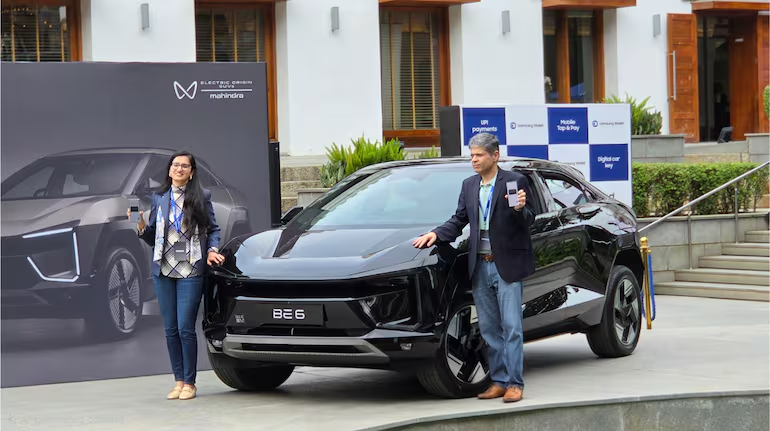
Samsung’s rollout of Digital Car Key support for Mahindra Electric Origin SUVs is set to redefine how Indian consumers approach vehicle security and convenience. Powered by Samsung Wallet, this integration allows users to lock, unlock, and start select Mahindra electric SUVs directly from eligible Samsung Galaxy smartphones, removing the need for physical keys. Key Features: Advanced Technology and Security Market Impact: Growing Digital Key Adoption The market for digital automotive keys is surging, forecast to grow from $1.7 billion in 2023 to $9.5 billion by 2033 at an annual rate of 18.8%. Luxury automakers have widely adopted proprietary digital keys, but Mahindra’s integration with Samsung Wallet marks a major leap for accessibility and user convenience in India—a move expected to disrupt market norms and accelerate smart car adoption. How It Works: Seamless User Experience Security First: Protection From Start to Finish Samsung’s Knox platform delivers robust security that goes beyond conventional passwords. All digital keys are encrypted and stored within Samsung Wallet, protected by hardware-based defenses and two-factor authentication options. If a device is misplaced, users can instantly revoke key access or wipe encrypted data to ensure the vehicle remains secure. Growing Galaxy Ecosystem Samsung has previously enabled digital car keys for brands such as BMW, BYD, and Mercedes-Benz, but its partnership with Mahindra signifies a tailored approach for the Indian market. This cooperation reflects Samsung’s ongoing commitment to expanding connectivity within the Galaxy ecosystem, creating an all-in-one hub for payments, identification, and now secure mobility. Expert Perspectives Nalinikanth Gollagunta, CEO of Mahindra’s Automotive Division, emphasized the company’s vision for first-class innovation and customer experience in India’s EV sector. “Our Electric Origin SUVs have captivated our customers with advanced features and futuristic design. Partnering with Samsung brings another first-in-class convenience digital car keys—that makes every journey smarter and safer,” he said. Madhur Chaturvedi, Senior Director for Services & Apps Business at Samsung India, added, “This partnership delivers on our promise of seamless, connected, and secure experiences for Galaxy users, making daily activities like driving more hassle-free”. User Experience: What Owners Can Expect Conclusion: A New Era for Indian Mobility The Samsung-Mahindra partnership ushers in a new epoch for automotive convenience and security in India. Digital car keys not only enhance daily user experience but also showcase the potential for smarter, greener, and more connected transportation. This innovation is set to drive both brands’ reputations as pioneers in the digital transformation of mobility—changing how millions engage with their vehicles. For more insights, subscribe The Business Tycoon
Zerodha to Launch US Stock Trading in 2026 as Revenue Declines

India’s largest discount stock broker, Zerodha, is set to introduce US equity trading for its users by the next quarter—an ambitious move coming as the company faces its first significant revenue decline in a decade. With this launch, Zerodha aims to tap into global markets via the GIFT City framework, catching up with rivals who already offer international trading. Zerodha’s US Stock Trading: What’s Changing? Zerodha CEO Nithin Kamath announced in an open Ask Me Anything (AMA) session that the platform would enable direct access to US stock investments in early 2026. CTO Kailash Nadh added that after years of technical and regulatory delays, “We now have requisite regulatory clarity through GIFT City” and are focused on building a “simple and seamless experience for users.” The company’s move will initially focus on access to US equities, with backend and frontend upgrades aimed at providing a smooth investing process for Indian retail investors. The Gujarat International Finance Tec-City (GIFT City) now provides a faster, more compliant route for international investing. Previously, investors faced hurdles due to remittance limits and operational bottlenecks. With GIFT City’s International Financial Services Centre Authority (IFSCA) regulations, Zerodha users can access global markets with fewer complexities. Why Is Zerodha Expanding Internationally? Zerodha’s strategic expansion comes at a challenging time. For the fiscal year 2025, the company reported a 15% decline in both revenue and net profit—down to ₹8,500 crore and ₹4,200 crore, respectively, from ₹10,000 crore and ₹5,500 crore in FY24. New regulations targeting futures and options (F&O) trading have significantly impacted the broker’s core earnings stream. Moreover, the company warns of a possible 40% drop in revenue for FY26 due to additional Securities Transaction Tax changes and further restrictions on popular derivatives trading options. This financial pressure is pushing Zerodha to diversify its offerings and reduce reliance on domestic F&O trading. Competing for Market Share: The Race with Rivals Zerodha’s late entry into US stock trading is seen as an effort to regain ground against competitors like Angel One, INDmoney, JM Financial, Axis Direct, HDFC Securities, Kuvera, and 5paisa, all of whom already allow Indian users to invest in foreign stocks. These platforms use similar GIFT City-based models to provide streamlined access to US equities. The timing is crucial as newer competitors have leapfrogged Zerodha in terms of active users. For example, Groww surpassed Zerodha’s active client numbers, highlighting the importance of global investing as a growth lever in India’s brokerage sector. Zerodha’s previous attempt to provide US stock market access in 2020 was stalled by COVID-19 disruptions and regulatory uncertainty—but the technology and compliance landscape have evolved. How Will US Stock Trading Work on Zerodha? Zerodha will leverage GIFT City’s two main platforms—India INX Global Access (from BSE) and NSE International Exchange (NSE IX)—to facilitate US stock investing. Most investors will trade in US shares via Unsponsored Depository Receipts (UDRs), with transactions settled in a T+3 cycle. The Liberalized Remittance Scheme (LRS) continues to apply, permitting up to $250,000 USD per year for overseas investments. The company has invested heavily in revamping its backend systems, ensuring tax compliance and regulatory reporting, and partnering with US-based brokers (as adopted by peers like INDmoney and 5paisa) so customers can seamlessly trade a wide range of US-listed companies. What This Means for Indian Investors For Indian retail investors, Zerodha’s launch offers a practical, regulated pathway to invest in global giants like Google, Apple, Tesla, and Meta without leaving their local brokerage account. The move also increases healthy competition and is likely to spur more innovation, better pricing, and new product features across the industry. Meanwhile, regulatory changes around F&O trading in India continue to alter risk and reward for young investors—a major demographic for Zerodha and its rivals. International diversification, once a niche play, is now a competitive necessity for platforms seeking long-term growth and customer loyalty. Key Takeaways Zerodha’s global ambitions reflect a wave of change in India’s financial sector—where successful brokers must continually innovate, respond to regulatory shifts, and meet investors’ growing appetite for global opportunities. For more insights, subscribe The Business Tycoon
Blackstone to Acquire 9.99% Stake in Federal Bank: A Strategic Investment in Indian Banking
Blackstone Inc., one of the world’s premier private equity firms, is set to acquire a 9.99% stake in Federal Bank, a major Kerala-based private sector bank. The $705 million (about Rs 6,196 crore) deal involves a preferential issue of warrants that will convert into equity shares, signaling a robust vote of confidence in Federal Bank’s potential and marking a notable moment in the rising trend of foreign investments in India’s mid-sized banks. Blackstone’s Deal Structure and Investment Terms The Federal Bank board has approved the issuance of approximately 27.29 crore warrants to Asia II Topco XIII Pte. Ltd., Blackstone’s Singapore-based affiliate, at a price of Rs 227 per warrant. Each warrant entitles the holder to subscribe to one equity share with a face value of Rs 2, including a share premium of Rs 225. By exercising all warrants, Blackstone will hold close to a 9.99% shareholding in the bank’s paid-up equity capital. Payment for the warrants is structured so that Blackstone will pay 25% of the warrant price at subscription and the remaining 75% upon conversion to equity shares. The warrants have an 18-month exercise period, after which any unexercised warrants will expire. The agreement also allows Blackstone the right to nominate one non-executive director to Federal Bank’s board once the stake reaches at least 5%, enhancing Blackstone’s active engagement in the bank’s governance. Federal Bank has scheduled an Extraordinary General Meeting (EGM) for November 19, 2025, to seek shareholder approval for the transaction. The deal is also subject to regulatory clearances from the Reserve Bank of India (RBI) and the Competition Commission of India (CCI). Foreign Investment Trends in Indian Banking Blackstone’s move comes amid a surge of global investments targeting India’s growing banking sector, especially mid-sized private banks with solid growth outlooks. Recently, Emirates NBD announced plans to invest $3 billion for a majority stake in RBL Bank, while Japan’s Sumitomo Mitsui Banking Corporation acquired a significant stake in Yes Bank for nearly Rs 15,000 crore. These transactions highlight India’s attractiveness as a high-growth market, bolstered by regulatory reforms that encourage foreign capital inflows into the financial services space. According to Bloomberg, financial services deals in India reached an estimated $15 billion in 2025, underscoring sustained investor confidence. Federal Bank’s Growth Prospects Federal Bank has demonstrated steady growth with customer assets rising 6% year-on-year to Rs 2.6 trillion as of June 2025. This investment by Blackstone not only infuses capital but is also expected to enhance the bank’s strategic capabilities through global expertise and board-level involvement. Following the announcement, Federal Bank’s shares reflected market optimism, surging as much as 2.2% before settling moderately higher. Investors view Blackstone’s stake acquisition as a validation of Federal Bank’s business model and growth strategy within India’s competitive banking landscape. Conclusion It’s acquisition of a minor but significant stake in Federal Bank aligns with the ongoing foreign investment wave reshaping Indian banking. This partnership promises to foster long-term growth for Federal Bank while providing Blackstone with exposure to one of the world’s fastest-growing economies. With regulatory approvals and shareholder nods pending, this deal is poised to become a landmark transaction in India’s banking sector. For more insights, Subscribe The Business Tycoon
F1 Mexico City Grand Prix 2025: High-Altitude Showdown as Max Verstappen Chases Championship Glory

F1 Mexico City Grand Prix 2025: The Ultimate High-Altitude Showdown The Formula 1 Mexico City Grand Prix 2025 promises pure excitement as the championship battle heats up. With the Autódromo Hermanos Rodríguez standing 2,285 meters above sea level, teams face the toughest technical test on the calendar. The demanding conditions could reshape the championship fight between Oscar Piastri, Lando Norris, and Max Verstappen – three rivals pushing their limits in pursuit of glory. Max Verstappen’s Title Momentum at Full Throttle After a dominant display in Austin, Max Verstappen is firmly back in the title mix. The reigning world champion has slashed his deficit from 104 points to just 40, sitting behind McLaren’s Oscar Piastri and Lando Norris. Red Bull’s ace enters Mexico riding a wave of momentum, with five victories at this circuit in the past seven years—a record unmatched by any competitor. Red Bull’s RB21 has thrived under similar conditions before, combining superior aerodynamic balance and power unit cooling efficiency to perform at altitude. Verstappen’s trademark consistency could make him unstoppable again on a track where he’s already a five-time winner. Mexico’s Thin Air: A Unique Technical Challenge At 2,285 meters, the Autódromo Hermanos Rodríguez pushes car engineering to its limits. The atmosphere here contains about 20% less oxygen compared to sea level, reducing engine performance and aerodynamic downforce. Teams must use maximum downforce setups similar to Monaco, yet still record Monza-level top speeds exceeding 346 km/h due to reduced air resistance. Mercedes engineers note, “The air is so thin that the car feels light and unstable, and cooling systems operate at their extremes.” Engine and brake temperatures soar, while tire degradation increases due to less oxygen and higher thermal loads. It’s a weekend where precision engineering, tire strategy, and driver control can make or break a race. Circuit Breakdown: Autódromo Hermanos Rodríguez Spanning 4.304 km with 71 laps, the Mexico City Grand Prix combines long straights, slow corners, and a stadium finale that vibrates with passionate fans. The event’s electric atmosphere peaks as cars dart through the Foro Sol stadium section, a converted baseball venue that houses thousands of roaring spectators. The mix of twisty corners and fast straights means teams must balance drag reduction with mechanical grip. Red Bull’s suspension stability gives them a clear edge, especially in the bumpy sections of the track. However, McLaren’s consistent tire management and high-speed cornering performance could neutralize some of that advantage. Key Strategies: Tire and Temperature Management Due to altitude, cooling is a major challenge. The thin air limits airflow through radiators and brakes, forcing teams to open up additional vents—compromising aerodynamic efficiency. Tire overheating is a serious risk, making a two-stop strategy the most likely approach. Maintaining tire integrity across the long straights and slow corners will determine success on Sunday. Energy recovery also becomes harder as reduced air density limits braking loads. Teams like Red Bull with efficient hybrid systems could gain small but vital advantages during acceleration phases. Full Race Weekend Schedule Friday, October 24, 2025 Saturday, October 25, 2025 Sunday, October 26, 2025 Fans in the U.S. can watch live on ESPN and ESPN+, while in the U.K., Sky Sports F1 and BBC Radio 5 Live will offer full coverage. Red Bull’s High-Altitude Mastery Red Bull’s aerodynamic excellence often shines at high altitudes, and Max Verstappen’s winning record in Mexico speaks for itself. With superior stability through high-speed corners and better traction off the line, Red Bull’s RB21 is ideally suited to the challenges of the Autódromo Hermanos Rodríguez. However, McLaren’s recent developments have narrowed the gap. Lando Norris’s qualifying speed and Piastri’s precision driving could make the front row a tightly contested battle. Ferrari and Mercedes remain outside title contention but could play spoilers if conditions or strategy turn unpredictable. Weather Outlook: Hot, Dry, and Demanding Forecasts predict clear skies and temperatures around 25°C throughout the weekend, ensuring consistent conditions across sessions. Although rain seems unlikely, the dry heat will test drivers’ endurance and tire performance. Teams must carefully monitor tire temperatures, as Mexico’s abrasive surface combined with high-altitude heat can rapidly degrade compounds. Mexican Grand Prix: F1’s Ultimate Festival of Speed The Mexico City Grand Prix is renowned not just for racing but for its extraordinary fan culture. The Foro Sol section provides one of the most electric backdrops in motorsport, turning each lap into a celebration of speed and national pride. As the 2025 Formula 1 season nears its climax, the stakes couldn’t be higher. Max Verstappen hunts for redemption, McLaren fights for supremacy, and Mexico’s thin air could be the setting where championship destinies shift. Every lap at this altitude counts. In a season where margins are razor-thin, the Mexico City Grand Prix 2025 could define the world championship. For more insights, Subscribe The Business Tycoon
Google Quietly Rolls Out Google Gemini 3.0 Pro: A Game-Changing Leap in AI Innovation
Google has taken the tech world by surprise once again. Without a major announcement or press release, the company has begun the silent rollout of its powerful new AI model, Google Gemini 3.0 Pro, to select users through the Gemini Advanced platform. This quiet launch, first reported by early testers, signals one of Google’s most daring moves in AI deployment to date — testing real-world performance before an official unveiling. A Stealthy Launch Strategy According to reports from Tom’s Guide and other sources, users of Gemini Advanced began receiving upgrade notifications stating, “We’ve upgraded you from the previous model to 3.0 Pro, our smartest model yet.”. Unlike traditional product reveals, Google opted to bypass media campaigns, letting organic discoveries fuel early hype. Many analysts say this shadow rollout mirrors the company’s strategy to conduct live beta testing on a small scale. This allows Google to fine-tune model outputs based on real user feedback before the expected official announcement around October 22, 2025. This move aligns with a growing trend among AI firms — emphasizing capability over spectacle. Google’s 3.0 Pro rollout showcases confidence in a model robust enough to stand on its own merit. Breakthrough Performance and Capabilities Google Gemini 3.0 Pro isn’t just an upgrade in speed or token capacity; it represents a transformative leap in creative, technical, and cognitive ability. According to testers, its leading features include: The result is an AI tool that feels more like a true digital systems designer than a chatbot, capable of creating operational web environments from basic textual commands. Future-Ready for Developers and Enterprises Beyond the buzz of AI enthusiasts, Gemini 3.0 Pro is engineered for deep industrial and enterprise application. Google’s internal communications point to its integration with Gemini for Workspace, enhancing products like Docs, Gmail, and Slides through smarter automation. In enterprise environments, Gemini 3.0’s coding and productivity enhancements bolster Google’s cloud ecosystem. It serves as both a generative partner and process optimizer—strengthening Google’s footing against rivals in the enterprise AI race. Thomas Kurian, CEO of Google Cloud, recently reiterated the company’s mission: “We’re democratizing how people can access AI.” Google’s suite now directly challenges Microsoft Copilot and OpenAI’s enterprise tiers with a $30 per-user monthly model under Gemini Enterprise. Strategic Positioning Against Rivals The quiet launch comes at a crucial time in the AI arms race of 2025. While OpenAI readies GPT-5 and Anthropic scales Claude 4.5 Sonnet, Google is betting on a multi-platform rollout that penetrates both consumer and business verticals. Reports suggest that Gemini 3.0 will not only power the Gemini Advanced chatbot, but also serve as the backbone for creative AI systems across Chrome, Android, and Workspace. This integration cements Google’s role as a leader in multimodal AI, leveraging its vast computational power and cloud footprint. As of 2025, nine of the top ten global AI research labs reportedly rely on Google Cloud infrastructure, underpinning over $100 billion in compute commitments. This depth in infrastructure, paired with the advanced capabilities of Gemini 3.0, underscores why Google remains a dominant AI innovator. Features That Set Google Gemini 3.0 Pro Apart What makes the Gemini 3.0 Pro rollout remarkable isn’t just stealth — it’s substance. Here’s why this release could redefine the landscape of digital creation: Anticipated Public Reveal Leaks across social platforms hint that Google’s full Gemini 3.0 launch event is imminent, likely aligning with a major marketing milestone on October 22, 2025. Internal documentation hinted at coordinated global updates to Gemini apps for Android and Chrome on the same day. If the release follows Google’s traditional rollout pattern, a broader release will likely include detailed feature explanations, developer updates, and Gemini API enhancements. The Future of Gemini and Google AI While the Gemini series has already cemented its reputation through 2.5 Pro and Flash iterations, the 3.0 Pro release signals a paradigm shift. Google’s commitment to quiet innovation — emphasizing product maturity over promotional hype — reflects confidence in what may soon become its most capable AI model. From a user perspective, Gemini 3.0 Pro seems more interactive, visually responsive, and intelligent than any prior version. For businesses, it represents a powerful asset in automation, design, and product development. As the AI race accelerates into late 2025, one thing is clear: Gemini 3.0 Pro is not merely an update — it’s a declaration of dominance. For more insights, follow The Business Tycoon
U.S. Chamber of Commerce Sues Trump Administration Over $100,000 H-1B Visa Fee

U.S. Chamber Challenges Trump’s $100,000 H-1B Visa Fee The U.S. Chamber of Commerce has launched a high-profile legal battle against President Donald Trump’s recent executive order imposing a $100,000 annual fee on H-1B visa applications. The nation’s largest business advocacy group claims the move will cripple American companies, especially startups and mid-sized firms that depend heavily on skilled foreign professionals. The H-1B visa program, which enables U.S. employers to hire specialized foreign workers in fields such as technology, engineering, and medicine, has been a cornerstone of the American innovation ecosystem for decades. Legal Grounds for the Lawsuit Filed in the U.S. District Court for the District of Columbia, the lawsuit alleges that the Trump administration exceeded its legal authority under the Immigration and Nationality Act (INA). According to the Chamber, the law permits visa fees only to the extent of covering administrative processing costs. The new $100,000 charge, they argue, is arbitrary and punitive, serving more as a deterrent rather than a cost-based adjustment. Neil Bradley, the Chamber’s Executive Vice President and Chief Policy Officer, stated that “President Trump’s unilateral action violates statutory limits and puts countless U.S. businesses at risk.” The lawsuit seeks an injunction to halt the enforcement of the fee, demanding judicial clarification on the constitutional boundaries of executive authority in immigration matters. Impact on the Business Community The reaction across the business community has been one of alarm. Companies in technology, engineering, healthcare, and academia warn that this drastic hike in costs could deter international talent from applying for U.S. jobs. The average cost of sponsoring an H-1B worker had previously ranged between $5,000 and $7,000, including legal and processing fees. The sudden escalation to $100,000 per employee could make the program uneconomical, especially for small and medium-sized enterprises. In sectors like tech, where foreign professionals make up a significant portion of the workforce, the new policy threatens to disrupt innovation pipelines. Experts note that approximately 75% of all H-1B visas are granted to Indian nationals, many of whom contribute to global firms such as Google, Microsoft, and Apple. Critics argue that restricting access to such talent could undermine U.S. competitiveness in artificial intelligence, cloud computing, and advanced manufacturing. White House and Administration’s Response The White House defended the policy, calling it a “necessary reform measure to protect American jobs.” Administration officials maintain that the visa program has been “widely abused” by corporations that allegedly replace domestic workers with lower-cost foreign labor. Commerce Secretary Howard Lutnick referred to the fee as a way to “encourage companies to hire locally while ensuring that the use of foreign labor is truly justified.” White House spokesperson Taylor Rogers reinforced this stance, saying the directive aligns with the President’s broader agenda of economic nationalism and border security. The fee, initially imposed for a one-year period, may be extended if deemed in the national interest. Tech Industry and Global Reaction The executive order has sparked widespread criticism from tech leaders around the world. Figures such as Elon Musk, Satya Nadella, and Sundar Pichai have spoken out, describing the H-1B program as vital for fostering innovation and maintaining America’s global leadership in technology. Many of these executives once benefited from the same program early in their careers. Industry analysts predict that if the fee remains in effect, many global tech firms could relocate operations abroad, channeling investments into more welcoming markets like Canada, Singapore, or the EU. Such shifts could mean billions in lost revenue and diminished U.S. influence in the global tech economy. Chamber’s Broader Economic Argument The U.S. Chamber of Commerce emphasized that while it supports President Trump’s initiatives on tax reform, deregulation, and energy policy, the visa fee undermines growth-oriented goals. The Chamber warned that the policy could lead to higher operational costs, a slowdown in hiring, and potential layoffs as companies struggle to offset the new expense. Bradley reiterated that the American economy cannot grow in isolation and that a balanced approach to immigration is essential to maintaining a dynamic labor market. The Chamber has urged Congress and the administration to collaborate on long-term reforms that balance worker protections with business realities. Also Read: Donald Trump Fires Four Senior Officials in Truth Social Post Possible Legal and Policy Outcomes Legal experts believe this case could set an important precedent on executive control over immigration and labor policy. Should the courts side with the Chamber, future administrations might face stricter limits in bypassing Congress on economic or immigration-related directives. However, if the fee is upheld, it may embolden the White House to take more aggressive unilateral actions across other visa categories like L-1 or OPT (Optional Practical Training). According to early estimates, the case could take months to resolve, with potential appeals reaching the Supreme Court given its constitutional implications. Meanwhile, American firms must decide whether to continue participating in the H-1B lottery system or wait for further legal clarity. Conclusion The lawsuit over the $100,000 H-1B visa fee has ignited a high-stakes battle between corporate America and the federal government. As the Chamber of Commerce’s challenge unfolds, the outcome will define not only the future of skilled immigration in the United States but also the broader balance of power between Congress and the presidency. Whether framed as an attempt to protect U.S. jobs or a barrier to global competitiveness, this dispute underscores a deeper tension between economic protectionism and the globalized workforce that has long fueled American innovation. For more insights, follow The Business Tycoon
OpenAI’s $1 Trillion AI Spend: Growth Ambitions, Financial Strain, and the Race for Dominance
OpenAI’s Unprecedented $1 Trillion AI Expansion Plan OpenAI, the creator of ChatGPT, has unveiled one of the most ambitious initiatives in tech history—spending over $1 trillion on artificial intelligence infrastructure within the next five years. This plan underscores CEO Sam Altman’s vision of positioning OpenAI as the backbone of the global AI economy, while simultaneously exposing the company to massive financial pressure. As of mid-2025, OpenAI’s annualized revenue stands at approximately $13 billion—doubling since January—yet its expenditures continue to soar. Despite record-breaking growth, the company reported an $8 billion operating loss in the first half of the year as it invests heavily in data centers, chips, and product development. Explosive Revenue Growth and Market Leadership OpenAI’s revenue has accelerated far beyond industry expectations. In the first half of 2025 alone, it generated about $4.3 billion—up 16% from the previous year—with projections suggesting annual revenue between $15 and $20 billion by the end of the year. Key drivers of this expansion include: With 800 million active users globally, OpenAI’s growth trajectory has redefined what’s possible in scaling AI-based platforms. New Revenue Streams: Shopping and Partnerships To reduce dependency on subscriptions, OpenAI is expanding into interactive commerce. The company has integrated shopping features into ChatGPT through partnerships with major retailers like Walmart, Shopify, and Etsy. Users can now purchase items directly within the chatbot, with OpenAI taking a percentage from each transaction. This “conversational commerce” push aligns with the firm’s broader goal of becoming an all-in-one digital assistant—a move expected to significantly boost engagement and transaction-based revenue streams. OpenAI is also exploring lower-priced subscription plans for emerging markets, including India and Brazil, to broaden its paying user base. Massive Infrastructure Commitments A key part of OpenAI’s trillion-dollar vision lies in scaling computing power. The company has secured agreements for more than 26 gigawatts of AI computing capacity through partnerships with global tech giants such as Nvidia, Oracle, AMD, and Broadcom. Highlights include: The Stargate project, initially valued at $500 billion, now anchors OpenAI’s infrastructure blueprint. Its flagship site in Abilene, Texas, is under construction and will serve as one of the largest AI data centers in the world. The Cost of Innovation: Financial Challenges OpenAI’s growth hasn’t come cheap. The company spent a staggering $6.7 billion on research and development during the first half of 2025, while also managing a $2.5 billion cash burn. Though these costs underscore its technological ambition, they pose serious financial challenges. To sustain operations and fund expansion, OpenAI is exploring multiple financing channels: Despite mounting expenses, Sam Altman has emphasized that long-term dominance—not short-term profitability—is the company’s priority. Strategic Partnerships Driving AI Ecosystem Growth OpenAI’s continued success is deeply intertwined with its strategic alliances. Microsoft, its largest investor and technology partner, contributes essential cloud infrastructure and product integrations like Copilot in Microsoft 365. Other collaborations, such as those with SoftBank and Oracle, are accelerating global data center construction. As the broader AI ecosystem rapidly evolves, these partnerships allow OpenAI to spread costs while securing access to top-tier compute resources—a necessity for scaling models like GPT-5 and future iterations. The Future Outlook: High Risk, High Reward OpenAI’s trillion-dollar investment strategy represents both a massive opportunity and an extraordinary risk. While the company projects potential revenues of $200 billion by 2030, up from $13 billion today, its success will depend on sustained innovation, efficient infrastructure scaling, and continued consumer adoption. If successful, OpenAI will not only cement itself as the central hub of the AI economy, but could also influence global GDP by reshaping how companies operate, automate, and innovate. However, financial volatility and aggressive spending mean the road ahead is uncertain. Investors and analysts alike will be watching closely as OpenAI attempts to balance cutting-edge innovation with fiscal sustainability in one of the most ambitious corporate undertakings of the 21st century. For more insights, follow The Business Tycoon
Nothing’s $200M Funding Fuels Breakthrough in Nothing AI-native device

London-based consumer technology brand Nothing has set the stage for the next chapter in smart devices by securing $200 million in Series C funding. This milestone boosts the company’s valuation to $1.3 billion and signals an ambitious pivot toward AI-native devices and latform. With CEO Carl Pei at the helm, Nothing aims to engineer a future where device intelligence is deeply personalized, intuitive, and seamlessly integrated into daily life. The announcement has drawn global attention, particularly as India emerges as a stronghold of Nothing’s rapid growth and market presence. Series C Funding: A Game-Changer Nothing’s latest funding round marks one of the largest investments in consumer tech for 2025, attracting heavyweights such as Nikhil Kamath, co-founder of Zerodha. Kamath’s backing reinforces the brand’s design-centric philosophy and underlines India’s growing influence in global tech investments. The $200 million capital injection will accelerate Nothing’s push into artificial intelligence, product innovation, and global expansion efforts. Vision for AI-Native Devices Carl Pei announced that Nothing’s first “AI-native devices” are scheduled for launch in 2026. Unlike traditional smartphones, these new products will serve as intelligent companions, designed to anticipate and act on users’ needs in real time. Pei hints at pioneering devices that blend hardware and software—creating hyper-personalized user experiences with “a billion different operating systems for a billion different people.” The London-based startup envisions hardware that works in tandem with adaptive, AI-driven software, reshaping how users interact with their devices. Pei stated, “For AI to reach its full potential, consumer hardware must reinvent itself alongside it”—a philosophy that places personalization and ambient intelligence at the core. Not Just Another Smartphone While Nothing’s Ear and Phone product lines have built recognition for their transparent casings and striking glyph lighting systems, the upcoming AI-native device promises to break away from smartphone conventions. Pei clarified that although smartphones will remain widespread for years, Nothing’s new device “will be just as important,” appearing as an ambient, always-available companion—possibly a wearable, smart pin, or innovative form factor yet to be revealed. Speculation abounds regarding the nature of this device. Industry experts suggest it could be a new kind of personal assistant: a device that provides intelligence “at the moment of need,” replacing screen-centric interactions with proactive, context-aware responses. AI-Native Platform: Essential and Playground Nothing’s journey toward an AI-native operating system began with the launch of its “Essential” AI platform. This ecosystem allows users to instantly create personalized applications using natural language and share them via Playground—a community hub for AI-generated and user-created apps. Essential empowers anyone to design task-specific apps, such as converting receipts to expense reports or creating mood trackers linked to playlists—an approach that challenges legacy software makers by centering openness, innovation, and hyper-personalization. Nothing’s Essential Apps and Playground represent an early step toward Pei’s “billion OS” vision: every device runs a version of the operating system uniquely tailored for its user. These hyper-personalized AI tools lay the groundwork for a future where devices anticipate and fulfill individual preferences. Design as Competitive Advantage Kamath’s investment in Nothing is rooted in the conviction that design is more than aesthetics—it is a strategic moat in consumer tech. Kamath stated that a product must be “recognizable from 10 feet away or in 6 seconds,” highlighting Nothing’s edge in the “affordable premium” segment. The company’s transparent hardware, signature visual cues, and emotionally resonant branding have set it apart in a commoditized market where most competitors rely solely on technical specifications and pricing. This design-forward strategy generates instant recognition among consumers and cements Nothing’s identity as a trendsetting innovator. India: Fastest-Growing Market Nothing’s impact is especially notable in India, where it has achieved remarkable market penetration. According to Counterpoint Research, Nothing recorded an astonishing 577% year-over-year growth, maintaining its status as India’s fastest-scaling smartphone brand for six consecutive quarters through Q2 2025. The company surpassed $1 billion in cumulative sales after shipping millions of devices worldwide. Nothing’s rapid Indian expansion includes 300 service centers and a retail network that doubled its offline presence from 2,000 to 5,000 outlets across the country. India has become a launchpad for Nothing’s innovations, and its growing influence signals global ambitions. The Road Ahead: AI, Hardware, and Beyond Looking forward, Nothing plans to introduce AI-native devices in 2026 that transcend the smartphone paradigm. The company is exploring concepts ranging from smart glasses and wearable pins to humanoid robots and electric vehicles—all built on the principles of hyper-personalized operating systems powered by AI. Carl Pei’s vision is clear: the age of one-size-fits-all tech experiences is ending. In soon-to-be-launched devices, intelligence will be present, ambient, and tailored. This ambitious roadmap places Nothing at the forefront of the AI revolution in consumer electronics. For more insights, follow The Business Tycoon
Gold Soars Above $4,000 an Ounce as Global Uncertainty Boosts Safe-Haven Demand

Gold has surged to unprecedented levels, breaking through the $4000 per ounce barrier for the first time in history. This remarkable rally reflects heightened investor caution amid broad concerns over global economic instability, political turmoil, and a weakening US dollar. With gold’s value rising by more than a third since April, the precious metal has quickly become a focal point for investors seeking security in volatile markets. Why Gold Prices Are Skyrocketing The current gold bull run is fueled by a complex mix of market and geopolitical factors. The announcement of new US tariffs by President Donald Trump earlier this year sent shockwaves through international trade, prompting investors to flee riskier assets. Additional anxiety has been stoked by a protracted US government shutdown, now entering its second week, which has delayed the release of crucial economic indicators and undermined confidence in policymaking. Historically, gold thrives in environments marked by uncertainty and unrest. Often hailed as a “safe haven,” gold tends to retain or increase its value when global equities and currencies stumble. As fears of a deeper downturn intensify, gold’s allure as a store of value has only grown stronger, making it the asset of choice for investors worldwide. A Look Back: Comparing Past Gold Rallies Analysts note that this is gold’s most significant rally since the 1970s. Traders remember that during previous US government shutdowns, like the month-long standoff in Trump’s first term, gold saw a rapid 4% uptick. Christopher Wong, a strategist at OCBC Bank in Singapore, highlights how political gridlock has consistently provided “tailwinds” for gold prices, and warns that even a swift resolution to the current shutdown could trigger a short-term drop in value. Nonetheless, investor appetite for hedging risk remains robust. Central Banks and Retail Investors Drive Demand While geopolitical turbulence is a major contributor, central banks have also played a pivotal role in fueling the contemporary gold rush. Since 2022, central banks across the world—including those of Poland, Turkey, India, Azerbaijan, and China—have collectively purchased over 1,000 tonnes of gold annually. This marks a stark increase from the yearly average of 481 tonnes accumulated between 2010 and 2021, reflecting a strategic pivot from US treasuries and dollar-denominated assets. Retail investors are also seizing on gold’s momentum. Many, wary of escalating risks in stock markets crowded by overvalued tech firms, have turned to exchange-traded funds (ETFs) backed by gold, which have attracted a record $64 billion in flows this year alone. Storage providers like Silver Bullion report doubling customer numbers, with a mix of banks, individual investors, and wealthy families seeking secure vaults for their precious metal holdings. Impact of US Dollar Weakness and AI Tech Warnings One reason for gold’s relentless ascent is the US dollar’s persistent decline, making commodities like gold cheaper and more attractive for foreign buyers. Coupled with this trend, there has been unease in equity markets, particularly as the Bank of England (BoE) recently warned that valuations of some top artificial intelligence tech companies appear “stretched.” The BoE cautioned of the possibility of a sharp market correction, defined as a 10% or greater fall in leading stock indexes. What Could Halt the Gold Rally? Despite gold’s dazzling performance, experts agree it is not immune to volatility. A sudden resolution of the US shutdown, surprising rate hikes by the Federal Reserve, or abating geopolitical risks could quickly sap gold’s momentum. Notably, in 2022, gold’s price plunged from $2,000 to $1,600 per ounce after aggressive interest rate hikes by the US central bank to tackle inflation post-pandemic. Greg Gregersen of Silver Bullion observes that while gold prices may eventually pull back, the “current economic environment points to an ongoing upward trend” that could last several years. OCBC’s Wong and UOB’s Heng Koon How add that even though a surge in global inflation or unexpected central bank actions could spark reversals, the broader demand—and gold’s unique status as a crisis hedge—remains as strong as ever. Outlook: Gold’s Role as a Safe-Haven Asset in 2025 With President Trump intensifying his criticism of the Federal Reserve and pressuring for quicker rate cuts, some investors are nervous about central bank independence and the credibility of global monetary policy. The Bank of England’s warning about market concentration in AI-focused tech companies only adds to the uncertainty. These overlapping risk factors support the view that gold will remain highly sought-after as a defense against unpredictable financial conditions for the foreseeable future. Conclusion Gold’s meteoric rise above $4000 per ounce in 2025 underscores its enduring appeal in times of turmoil. As economic and political uncertainties mount worldwide, gold’s resilience and stature as a safe haven continue to attract both institutional and retail investors. While the potential for sharp corrections remains, the strength of gold’s rally is a powerful indicator of broader anxieties—and the enduring need for financial security in today’s turbulent climate. For more insights, follow The Business Tycoon