
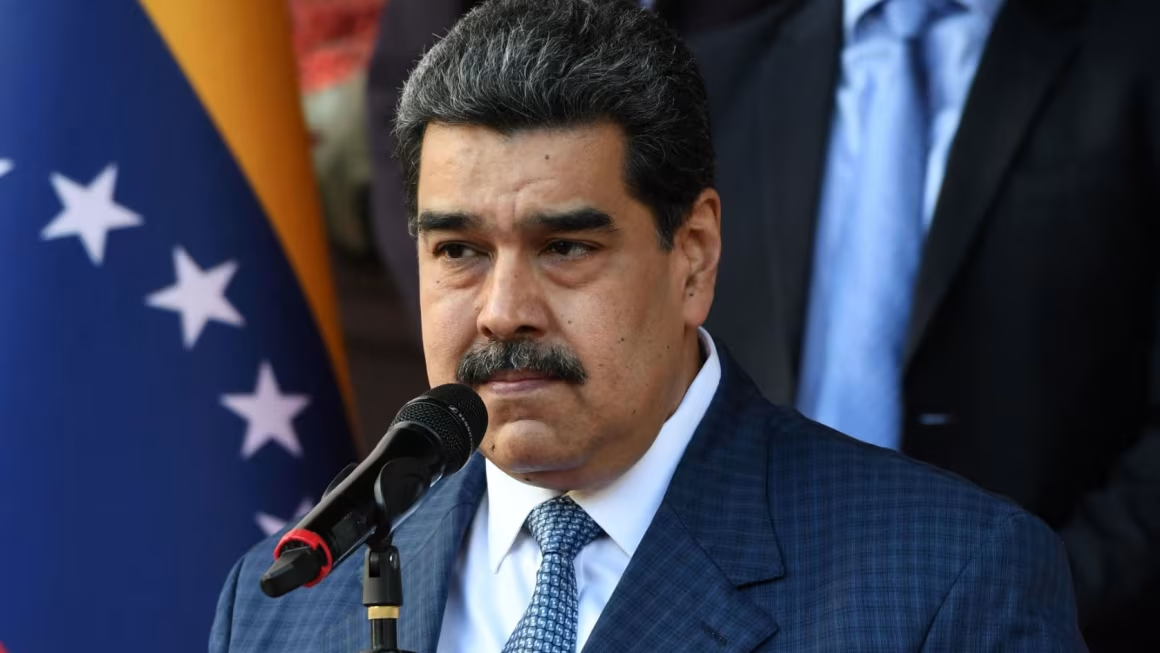
While oil prices dipped on Monday, January 5th, 2026, due to rising geopolitical tensions created by US actions in capturing Venezuelan President Nicolas Maduro during their surprise operation over the weekend. This news has generated much discussion within the news media and around the world; however, it appears that financial markets have remained relatively uninfluenced by this event, as it is considered that there is not expected to be a short-term negative effect on energy supplies.
There were slight increases in US benchmark prices of crude oil after the start of trading; however, these early increases have been reversed, and now the price has decreased 36 cents to US $56.96 per barrel. Additionally, the prices of Brent (the global price of crude oil) also have decreased 34 cents to US $60.41 per barrel.
The price of oil is currently trading at or near its lowest price point in approximately six months due to the abundance of supply provided by producers globally, plus the likelihood of decreased future demand from some of the major consuming countries around the world, as they appear to be decreasing their consumption levels.
Venezuela’s Oil Industry Faces Long Road to Recovery
The energy sector in Venezuela has been in consistent decline for many years, despite the fact that Venezuela has the largest proven oil reserves in the world. Mismanaged for an extended period of time, poorly maintained equipment and a surplus of oil infrastructure will significantly reduce oil production in Venezuela today. Currently, Venezuela produces approximately 1.1 million barrels of oil per day, considerably less than Venezuela’s historic production levels. While some analysts see Venezuela potentially increasing oil production levels to double or triple in the coming years, they emphasise that years of sustained investments in oil infrastructure as well as the support of Venezuela’s governmental stability will be needed to make that happen. Markets continue to discount the likelihood of a sudden increase in U.S. oil supply or of any supply disruption caused by a U.S. military operation due to sufficient global oil inventories in supply and a lack of concern among traders regarding supply shocks.
Markets Signal Confidence, Not Panic
Most financial analysts have noted that despite recent media focus on Venezuela’s President Nicolas Maduro being captured, financial markets have largely shown little reaction. “We think that there is a general feeling among participants in the financial market community that the short-term impact on the economy and financial markets as it relates to the U.S. sanction against Venezuela is expected to be minimal,” said Thomas Mathews of Capital Economics. “The general consensus among financial analysts is that while Maduro’s capture is being reported widely, the short-term financial and economic implications are expected to be fairly small.” There is still considerable doubt, however, regarding President Trump’s intention to deploy U.S. troops to oversee the transition of power in Venezuela, further complicating the geopolitical landscape for investors to monitor going forward.
Gold and Silver Surge as Investors Hedge Risk
Oil prices have eased, while precious metals are up sharply, indicating that investors are quietly adding hedges against geopolitical risk.
- Gold rose by 2.7%.
- Silver rose by 6.6%.
These gains indicate a pattern that has emerged many times before; even when investors are confident about equities, they tend to seek alternative investments and/or insurance from political instability through maintaining an allocation to fully invested safe-haven stocks and bonds.
According to Stephen Innes from SPI Asset Management, “This is a sign of investor confidence with a hedge rather than pure excitement over the potential for growth in equities.” He states, “Investors want to participate in an environment that offers greater risk than they currently operate in, but they also want to safeguard themselves against rapid changes in the environment.”
Asian and European Markets Rally Strongly
Markets in Asia and Europe have enjoyed strong performance, supported by strengths in the technology sector.
Asian markets:
- The Nikkei 225 was up 3% today, providing the highest close in October 2021.
- The Kospi was up 3.4%, with a new high of 3888.82.
- The Taiwanese market gained 2.6% on the day.
- The S&P/ASX 200 was unchanged.
European markets were also generally higher today:
- The DAX finished the day up 0.8%.
- The CAC 40 ended the day up 0.3%.
- The FTSE 100 closed 0.2% higher.
Futures for the US equity markets also point upwards today, demonstrating the enthusiasm of investors as they begin the new trading year of 2026.
Investors Look Ahead to Key U.S. Economic Data
Many of the US economy reports released this week are followed closely by many people (like us) because they give them a better understanding of where the economy stands at the very end of 2025 and where it will proceed into 2026. Also, as the Federal Reserve prepares for their upcoming January 2023 meeting, the public and investors hope that this data provides clear information regarding how things will be for the US economy. Investors have been particularly focused on becoming better informed, as there continues to be strong geopolitical uncertainty and changes in interest rates and monetary policy forecasts.👉 For more expert insights on global markets, geopolitics, and business trends, visit:
🔗 https://thebusinesstycoonmagazine.com/