
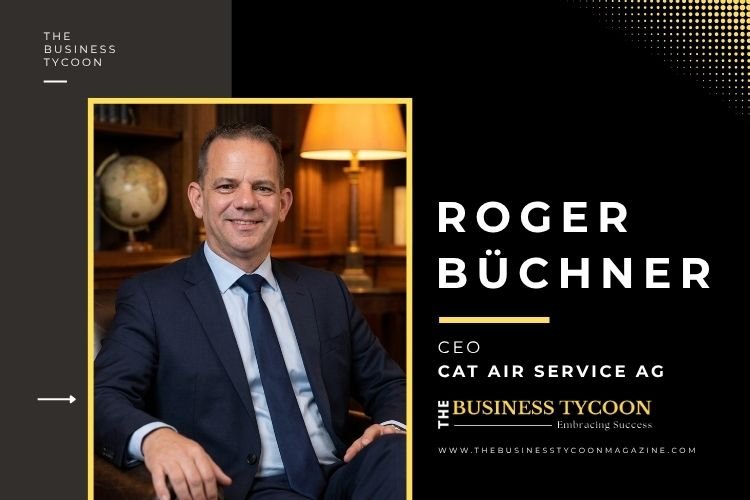
Roger Büchner: Where Precision Meets Personal Leadership in the World of Aviation
Building Cat Air Service AG on Trust, Flexibility, and the Human Side of Ground Handling
At an international airport, every arrival and departure is a carefully coordinated sequence of people, procedures, technology, timing, and decisions. In Business Aviation, however, the equation becomes even more personal. Expectations are exceptionally high, schedules can shift within minutes, and every passenger, crew member, aircraft operator, and flight can bring a different set of requirements. Behind the apparent simplicity of a smooth journey on the ground is an intricate operation where reliability, discretion, flexibility, and safety must work together without compromise.
In this demanding environment, Roger Büchner, CEO of Cat Air Service AG, has built his leadership journey.
Based at Zurich Airport, Cat Air Service is a Swiss ground-handling company specializing in Business Aviation and General Aviation. Founded in 2014 with a team of approximately five employees, the company has steadily developed into an organization of around 15 people, with further growth and operational development planned for the years ahead. Yet the most meaningful measure of its progress may not be its increasing size. It is the company’s ability to grow while preserving the personal character that defined it from the beginning.
For Büchner, ground handling is far more than a technical process. It is about taking ownership of the customer experience on the ground and ensuring that every moving part comes together with professionalism and care. That philosophy has become central to Cat Air Service’s identity, and to Büchner’s approach to leadership.
Starting Small in a Highly Demanding Industry
Launching a ground-handling business at an international airport is not an undertaking for the faint-hearted. Aviation operates in a highly regulated environment where safety, security, training, operational procedures, and compliance are fundamental requirements rather than optional differentiators.
When Cat Air Service began in 2014, the company faced the challenge of establishing itself within an existing market while operating with a relatively small team. It needed to show that a smaller organization could meet aviation’s demanding standards while offering customers a meaningful alternative to larger providers.
In the early days, this meant every team member had to be prepared to go beyond a narrowly defined job description. People had to stay flexible, take responsibility, and understand how their decisions could shape the overall customer experience.
What initially seemed like a limitation gradually became an advantage. The small team developed a strong sense of collective responsibility. Employees were close to the operation, decisions could be made quickly, and everyone understood that their contribution mattered. Rather than creating layers between leadership and daily operations, the company developed a culture in which people were directly connected to the outcome.
For Büchner, that experience reinforced a lesson that continues to influence his leadership: an organization becomes stronger when its people understand they contribute to its success, not merely participate in a process.
Growth Built One Relationship at a Time
No single dramatic moment transformed Cat Air Service into a growing organization. Instead, its progress has been gradual, relationship-driven, and rooted in consistency. In Business Aviation, trust carries enormous weight. Customers need to know that when they arrive at an airport, their requirements will be understood and handled professionally. Operators and crews need confidence that the ground team will respond when circumstances change. Partners need to know that commitments will be honored.
Cat Air Service focused on delivering precisely that kind of reliability. As customers experienced the company’s flexibility and service quality, long-term relationships developed. Recommendations followed. Greater volumes of aircraft movements created opportunities to invest further in employees, equipment, capabilities, and infrastructure.
The journey from approximately five employees in 2014 to around 15 today therefore represents more than numerical growth. It reflects years of accumulated trust. For Büchner, sustainable growth is not about pursuing expansion simply for the sake of becoming bigger. It is about ensuring that the company’s people, infrastructure, operational capabilities, and service quality evolve together.
That distinction is particularly important in aviation, where growth without adequate operational foundations can create its own risks. Cat Air Service’s approach has instead been measured: grow where the organization can maintain its standards, invest where those investments strengthen its capabilities, and remain close enough to customers to understand what they genuinely need.
The Three Foundations Behind Sustainable Success
When asked what has contributed most to Cat Air Service’s long-standing success, Büchner identifies three interconnected elements: people, customers, and flexibility.
The first is people. Aircraft, equipment, and procedures are essential to aviation operations, but the quality of service ultimately depends on the individuals executing those processes. A motivated employee who understands a customer’s needs and takes responsibility can transform an otherwise routine interaction into a memorable experience.
The second foundation is the customer relationship. Rather than approaching every operation through a rigid standardized model, Cat Air Service aims to listen carefully and understand the specific requirements of each customer. Business Aviation is inherently individual. What one operator considers routine may be highly unusual for another. What matters is the ability to understand those differences and respond appropriately.
The third foundation is flexibility. A smaller organizational structure can provide a valuable advantage when circumstances change quickly. Decisions can be made closer to the operation, communication can remain direct, and unusual or last-minute requirements can be addressed without unnecessary layers of approval.
But Büchner draws an important boundary around flexibility. Flexibility can never come at the expense of safety or compliance. In aviation, the ability to say “yes” to a customer must always exist within the boundaries of what can be done safely and responsibly. That balance, being adaptable without becoming careless, is one of the defining characteristics of mature aviation leadership.
Leadership That Stays Close to the Operation
The modern leadership landscape is changing rapidly. Customer expectations continue to evolve, technology is advancing, regulations are becoming increasingly demanding, and employees themselves have changing expectations about their workplaces and leaders. For Büchner, one of the greatest leadership challenges is therefore managing constant change without losing connection with the people responsible for delivering the company’s work.
His answer is remarkably practical: leaders need to remain close to their employees and close to the actual operation. Leadership, in his view, cannot exist entirely behind a desk. Decisions become more meaningful when leaders understand the realities faced by their teams. Employees are also more likely to engage when they understand not only what they are being asked to do, but why it matters.
Communication consequently becomes one of the most important leadership tools. Büchner believes employees should have responsibility and opportunities to develop, while also knowing that leadership remains available when support or a decision is required. Trust, in this context, is not about removing accountability. It is about giving capable people enough space to contribute while providing the guidance necessary to succeed.
His approach can be summarized through four principles: listen, communicate openly, make decisions when necessary, and remain accessible. In an industry where a small operational detail can have significant consequences, that grounded approach provides an important leadership advantage.
Innovation Does Not Always Need to Be Revolutionary
The word “innovation” is often associated with breakthrough technology, automation, artificial intelligence, or major digital transformation. Büchner offers a more operational perspective. For Cat Air Service, innovation can be found in the small improvements that make a process safer, faster, clearer, or more efficient.
Aviation is an industry of continuous learning. Regulations evolve. Safety requirements change. Aircraft types develop. Customer expectations shift. Technology introduces new opportunities. The knowledge required to operate successfully therefore cannot remain static. Formal training is an important part of that equation, but Büchner also recognizes the value of learning that takes place during everyday operations. Experienced employees can transfer practical knowledge to newer colleagues. Meanwhile, employees working directly in the operation can identify improvements that may not be immediately visible from a management perspective.
This creates a two-way learning culture. Management does not have a monopoly on ideas. The people closest to the work often see opportunities for improvement first. Creating an environment where employees feel comfortable making suggestions therefore becomes a form of innovation in itself. At Cat Air Service, continuous improvement is not necessarily about reinventing the entire operation. Sometimes the smallest procedural or communication change can create a meaningful improvement in the customer experience.
Technology With a Human Face
Technology has fundamentally changed how aviation organizations communicate and coordinate. Digital communication, operational systems, and electronic documentation allow information to move faster between aircraft operators, crews, handling teams, airport partners, and authorities. In Business Aviation, where schedules can change with little notice, that speed can be invaluable. Technology enables Cat Air Service to prepare more efficiently, coordinate more effectively, and respond faster when plans change. But Büchner is careful not to position technology as a replacement for people.
For Cat Air Service, technology is a tool that supports its employees rather than substitutes for them. That distinction matters because Business Aviation remains deeply human. Customers may need more than information from an operational system. They may need someone who understands their situation, recognizes the urgency, and takes personal responsibility for finding a solution. The combination of digital efficiency and human accessibility therefore becomes particularly powerful. Technology can accelerate communication. People provide judgment, empathy, accountability, and adaptability. Cat Air Service seeks to bring both together.
A Different Kind of Disruption
Büchner does not describe Cat Air Service as a traditional technology disruptor. Its differentiation comes from something more fundamental: demonstrating what a specialized, relatively small organization can accomplish in a highly demanding international airport environment. Its structure allows short decision-making paths and direct communication. Customers can communicate with people who understand their requirements rather than being passed through multiple organizational departments. That creates a distinctly personal experience. A customer should never feel like merely another flight number.
That philosophy captures the essence of Cat Air Service’s positioning. Professional standards are essential, but professionalism does not need to create distance. A company can maintain rigorous operational discipline while remaining approachable, responsive, and personal. In many ways, this is where the company’s smaller scale becomes an asset rather than a limitation.
Diversity as Part of Everyday Aviation
Zurich Airport sits within an inherently international environment. Every day, Cat Air Service works with individuals from different countries, cultures, professional backgrounds, and perspectives. For Büchner, diversity and inclusion therefore do not need to exist only as formal corporate statements. They are already part of the everyday reality of aviation. When selecting and developing employees, he emphasizes competence, reliability, motivation, respect, and the ability to work effectively as part of a team. A person’s nationality or background should not determine their opportunities.
Different experiences can strengthen an organization, particularly one operating in an international environment where communication and cultural awareness are important parts of customer service. But diversity also requires something more basic: respect. Every employee should be treated fairly and given the opportunity to contribute. A workplace becomes stronger when people feel that their perspectives have value and that their contributions are recognized. This philosophy supports the same human-centered culture that defines Cat Air Service’s approach to customers.
Competing Beyond Price
The Business Aviation market can be influenced by economic conditions, geopolitical developments, regulatory changes, and shifting travel patterns. Remaining competitive therefore requires constant observation and willingness to adapt. Cat Air Service regularly reviews its operational processes, staffing requirements, equipment, infrastructure, services, and market positioning. Financial discipline matters. So does investment in the future. Yet Büchner does not believe the company should compete primarily on price.
In an industry where safety, reliability, responsiveness, and service quality directly influence customer confidence, these qualities carry genuine value. The objective is not simply to offer a lower price. It is to offer customers a level of professionalism and personal attention that makes the relationship worthwhile. That is why sustainable growth remains more important to Büchner than growth at any cost.
Preparing for the Next Chapter
Cat Air Service’s expansion has not revolved around one conventional “product launch.” Instead, the company has continuously developed its operational capabilities. Its team has expanded. Its organizational structure has strengthened. Its resources and capabilities have developed alongside its growing customer base. Further investment in infrastructure and operational capacity is planned for the coming years. Yet the company’s ambitions remain measured. The goal is not simply to become larger. The goal is to become stronger while preserving what customers already value.
That means ensuring that additional business does not dilute personal service. It means ensuring employees have the training and resources required to perform effectively. It means ensuring infrastructure grows alongside operational demand. And it means protecting the standards of safety and compliance that form the foundation of aviation. For Büchner, successful expansion is therefore ultimately about balance.
The Human Standard Behind Every Smooth Journey
From the outside, ground handling can appear to be a collection of technical tasks carried out between an aircraft’s arrival and departure. But Cat Air Service’s story reveals a deeper reality. Every smooth operation depends on people who communicate, anticipate, coordinate, solve problems, and take responsibility. Roger Büchner’s leadership philosophy is built around that human reality. His journey with Cat Air Service demonstrates that a company does not necessarily need enormous scale to make a meaningful impact. It needs clarity about what it stands for, people who believe in that purpose, customers whose trust is earned repeatedly, and leaders willing to remain close to the work.
Since 2014, Cat Air Service has grown from a small five-person team into an organization of around 15 employees, with further development on the horizon. But the company’s most valuable achievement may be its ability to grow without losing its original character. In an industry defined by precision, Büchner has placed equal importance on something that cannot be measured purely through systems or procedures: personal responsibility. For Cat Air Service, the aircraft may be the center of the operation, but people remain at the center of the service.
And perhaps that is the leadership lesson that extends far beyond aviation: sustainable success is not created by choosing between efficiency and humanity. It comes from building an organization where both can reinforce one another.
As Cat Air Service prepares for its next phase, its direction remains clear: continue developing, continue investing, continue adapting, and above all, continue being a trusted and flexible partner for Business and General Aviation at Zurich Airport. Under Roger Büchner’s leadership, the company’s story is not simply about how far it has traveled. It is about how carefully it intends to continue the journey.
LinkedIn: https://www.linkedin.com/in/roger-b%C3%BCchner-9a74a762/
Instagram: https://www.instagram.com/catairservice/
Website: https://www.cat-airservice.com/