
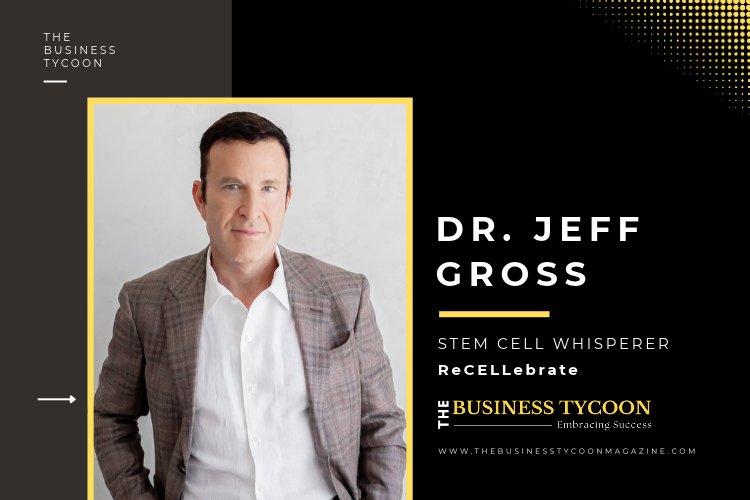
Beyond the Limits of Conventional Care: Dr. Jeff Gross and the New Frontier of Regenerative Medicine
Redefining What Healthcare Can Make Possible
Healthcare innovation is often measured by the sophistication of a procedure, the introduction of a new technology, or the ability to treat conditions that once seemed difficult to address. For Dr. Jeff Gross, the “Stem Cell Whisperer,” and his pioneering vision behind ReCELLebrate™, the ambition extends beyond managing symptoms toward exploring advanced regenerative approaches that have been demonstrated to improve function, support recovery, and offer alternatives to conventional treatment pathways. His work reflects a forward-looking perspective on healthcare, where scientific advancement, personalized attention, and patient education come together to explore new possibilities in regenerative medicine.
His professional vision emerged from a growing frustration with the American healthcare (a.k.a. “sick care”) system and the difficulties patients encountered while attempting to navigate it and the rationing of resources. Many were seeking modern treatment options that could help reduce their dependence on pharmaceuticals or potentially avoid extensive procedures such as joint replacements and spinal fusions. Their experiences highlighted a gap between the care patients wanted and the options they believed were available to them. Rather than accepting that gap as an unavoidable feature of healthcare, Dr. Gross saw an opportunity to build a more responsive model centered on advanced treatment options, individualized attention, and a deeper understanding of patient needs and desires
This vision has shaped his approach to regenerative medicine, an evolving field that explores biological strategies to support the body’s repair processes. Through specialized services involving joints, the spine, and broader health and wellness concerns, Dr. Gross seeks to make emerging therapeutic options more accessible to patients who may be looking for alternatives to conventional approaches. His work reflects a wider shift in modern medicine, where innovation is increasingly accompanied by questions about personalization, treatment selection, long-term function, and the quality of the patient experience.
For Dr. Gross, however, innovation is not simply about offering something new. It is about creating a meaningful connection between scientific advancement and the people who may benefit from it. That requires more than technology or technical expertise. It demands education, careful evaluation, responsible decision-making, and the willingness to spend time understanding each patient’s circumstances. These principles form the foundation of his approach to building a healthcare practice that places quality and individual needs at the center of its mission.
Building a Practice Around a Better Patient Experience
The founding vision behind Dr. Gross’s work was shaped by two closely connected realities: the limitations patients experienced within the healthcare system and the frustration of navigating treatment choices without always having access to the information or alternatives they needed. Patients seeking relief from musculoskeletal pain or looking to preserve mobility often face complex decisions involving medications, injections, and potentially extensive surgery. The challenge is not simply identifying a treatment, but understanding which options are appropriate for a particular person and what each option may realistically offer.
Dr. Gross’s response has been to develop a practice that emphasizes advanced regenerative approaches while giving patient education and personalized care a central role. The objective is to explore suitable but more expanded treatment options before patients commit to more extensive interventions, where clinically appropriate. This philosophy does not reduce healthcare to a competition between traditional and emerging medicine. Instead, it encourages a more informed examination of available choices, with decisions guided by individual circumstances, medical evidence, and professional evaluation. These choices may include stem cells, exosomes, growth factors, and peptides, all with growing popularity globally.
Such an advanced healthcare delivery model also recognizes that patients bring different expectations, concerns, and definitions of success to their medical journeys. One individual may prioritize reducing pain and returning to everyday activities, while another may be focused on maintaining mobility, improving physical function, or understanding whether a less invasive approach is desirable. A standardized medical interaction can struggle to accommodate these differences. Dr. Gross therefore places importance on spending sufficient time with patients, listening carefully, and adapting the care experience to their personalities and preferences, while educating his patients thoroughly
This emphasis on time and communication is particularly significant in a healthcare environment where appointments and administrative demands can make personal interactions limited and frustrating for all parties. For Dr. Gross, quality care involves making patients feel heard rather than treating their concerns as another item in a clinical workflow. By combining specialized services with individualized attention, his approach seeks to make each patient experience more transparent, considered, and responsive. That approach may be the reason that his outcomes are superior to those of traditional clinicians.
Challenging Barriers Through Education
Introducing advanced treatment options involves challenges that extend beyond clinical practice. One of the major obstacles Dr. Gross encountered was the frustration patients experienced when their health insurance did not cover the care they needed. When people expect a treatment to be included in their coverage, discovering that it may not be reimbursed creates uncertainty, financial concerns, and disappointment. It can also make conversations about emerging therapies more complicated, particularly when patients are unfamiliar with how insurance benefits are structured. Sadly, they often do not find out until there is a need.
Dr. Gross recognized that addressing these concerns required a broader educational effort. Patients and consumers needed a clearer understanding of what their insurance plans actually covered, how available benefits differed from their expectations, and why certain advanced care options might fall outside their coverage. The challenge was not merely to explain a service, but to help people become better informed participants in their healthcare decisions.
Education also played an important role in navigating what Dr. Gross described as regulatory misconceptions surrounding regenerative medicine. Through research into the regulatory landscape and efforts to communicate more clearly with consumers, he sought to distinguish misunderstandings from the realities of compliant treatment delivery. This work has helped create a stronger foundation for fully discussing regenerative options, including stem cell-derived biologics, MUSE stem cells, exosomes, and therapeutic peptides.
In a field where scientific progress, public expectations, and regulatory requirements intersect, clarity is essential. Emerging treatments can attract considerable attention, but responsible communication requires that their potential is not confused with guaranteed outcomes. Patients need to understand what is being offered, why it may be considered, and what limitations or uncertainties may apply. By making education part of the business model, Dr. Gross has always positioned informed decision-making as a necessary complement to innovation.
His experience illustrates an important lesson for healthcare entrepreneurs seeking the best outcomes: meaningful progress often depends on more than developing a new service. It also requires building the understanding, trust, and operational processes that allow people to evaluate that service responsibly. Overcoming barriers becomes a combination of scientific awareness, regulatory diligence, transparent communication, and a willingness to address the practical questions that matter to patients.
Regenerative Medicine: Expanding the Possibilities of Care
At the center of Dr. Gross’s practice is a commitment to exploring regenerative approaches for patients experiencing joint and spinal conditions. His services include regenerative injections involving stem cell-derived biologics, with the aim of supporting cartilage regeneration, reducing pain, and improving physical function. For individuals facing the possibility of joint replacement or spinal fusion, these approaches represent an opportunity to discuss whether less invasive alternatives may be appropriate before (or as a complete alternative to) proceeding with major surgery.
The potential applications of regenerative medicine extend beyond musculoskeletal concerns. Dr. Gross also described the use of stem cell-derived biologics in addressing certain systemic inflammatory concerns, alongside educational and coaching services involving therapeutic peptides. These services respond to a broader interest in health optimization, including body composition, muscle mass, fat loss, cognitive function, and energy. Together, they reflect a practice that considers both the treatment of specific complaints and the wider aspirations people may have for their health and well-being.
What distinguishes this approach is the effort to connect specialized treatment options with a more comprehensive understanding of individual needs. Healthcare is rarely defined by a single objective, and patients may approach treatment with overlapping concerns about pain, mobility, physical performance, or quality of life. Addressing these concerns requires careful assessment and a realistic discussion of available options rather than an assumption that one intervention will suit everyone.
At the same time, regenerative medicine remains an evolving area of healthcare. Outcomes depend on the problem being addressed, the intervention selected, the patient’s circumstances, and the quality of the available evidence. No treatment can guarantee that surgery will be avoided or that a particular degree of regeneration will occur, but at the same time, surgical outcomes are also never guaranteed. Dr. Gross’s emphasis on patient education and individualized care is therefore especially relevant to helping people understand the possibilities and limitations of emerging therapies.
His work reflects a wider ambition to broaden the conversations patients can have with their healthcare providers. Rather than viewing treatment decisions as a choice made only after conventional options have been exhausted, the goal is to encourage earlier, informed discussions about appropriate alternatives. In this context, innovation is as much about improving the decision-making process as it is about introducing new therapeutic tools.
Evidence, Quality, and the Meaning of Success
For any healthcare organization working at the intersection of innovation and patient expectations, credibility must be earned through consistent attention to quality. Dr. Gross identifies evidence-based care, results-focused service, and personalization as the principles that guide his practice. These values shape the way his team interacts with patients, evaluates their needs, and seeks to deliver a service experience that differs from the more impersonal encounters many people associate with the broader healthcare marketplace.
One milestone he highlighted during the conversation was the number of patients who had received regenerative joint or spinal injections through the practice. At the time of the interview, that figure had surpassed 800. He also reported a success rate exceeding 98 percent in using regenerative injections to avoid an already recommended surgery elsewhere. These figures were presented as practice-reported achievements and reflect the benchmarks Dr. Gross considers important to evaluating the organization’s progress.
Equally revealing is how Dr. Gross interprets the remaining cases. He explained that in a small percentage of patients who do not achieve the desired result are not automatically considered failures. Instead, they warrant another assessment, a closer examination of their circumstances, and potentially a different care plan. This perspective recognizes that healthcare outcomes are not always straightforward and that an initial single treatment may not resolve every concern.
Such an approach places continued evaluation at the heart of patient care. It encourages clinicians to look beyond a single outcome and consider what further information or alternative approaches may be appropriate. For patients, this can reinforce the importance of ongoing communication and realistic expectations. For the organization, it creates an incentive to examine performance, learn from individual experiences, and refine its processes.
Dr. Gross also points to strong Google Business reviews as an important indicator of the practice’s reputation. Patient feedback, particularly when it recognizes individual team members, provides an opportunity to understand how service is experienced beyond the clinical procedure itself. Responsiveness, clarity, courtesy, and the quality of communication all contribute to the overall impression a patient takes away.
Ultimately, sustainable healthcare leadership requires more than the introduction of advanced services. It depends on a culture that takes feedback seriously, treats patients as individuals, and remains prepared to reassess decisions when results do not match expectations. For Dr. Gross, these commitments are integral to building a modern evolved health care practice whose reputation rests on both the type of care it provides and the way it delivers that care.
Developing People to Deliver Better Care
Innovation is frequently associated with technology, yet its effectiveness also depends on the people responsible for putting it into practice. Dr. Gross approaches team development with the understanding that employees need the right skills, resources, and encouragement to deliver a consistently high standard of service. His philosophy combines recognition, continuing education, and the practical use of technology to improve everyday operations.
Customer reviews play a role in this process. When patients specifically recognize an employee’s contribution, the feedback can serve as a form of acknowledgement and reward. This approach connects individual performance with the experiences of the people the organization exists to serve. It also reinforces the idea that exceptional service is not limited to clinical expertise; every interaction can influence how patients perceive the practice.
Dr. Gross also supports professional development through opportunities such as training in sales, customer service, and artificial intelligence. These areas may appear different at first glance, but they address complementary needs within a modern healthcare business. Communication training can help employees explain services more clearly, customer service development can strengthen patient relationships, and AI education can help teams identify tasks that may be streamlined through appropriate technology.
The objective is not simply to make employees complete more work in less time. Greater efficiency should create additional capacity for more meaningful human interactions. Dr. Gross wants his staff to spend less time on repetitive administrative duties and more time extending the practice’s care philosophy to patients and prospective customers. Technology becomes valuable when it supports that objective rather than distracting from it.
He also recognizes the importance of having relevant patient information readily accessible. Better software and more streamlined systems can help staff respond to enquiries efficiently, retrieve information when needed, and coordinate their work with greater consistency. In a service environment where patients may have questions about treatment options, appointments, or their individual circumstances, timely access to accurate and protected health care information can make a significant difference to the experience.
This combination of team development and operational improvement reveals a broader understanding of leadership. Building an innovative organization requires more than selecting the right tools. Leaders must help their teams understand why change matters, provide opportunities to develop new capabilities, and ensure that efficiency serves a meaningful purpose. By investing in both human skills and technological support, Dr. Gross seeks to create an environment in which operational performance and patient-centered care reinforce one another.
Looking Ahead: Precision as the Next Frontier
Dr. Gross’s future vision centers on advancing the precision with which regenerative treatments can be delivered. During the interview, he described plans to open a robotically assisted injection facility incorporating three-dimensional computed tomography imaging and guidance, alongside magnetic resonance imaging-based targeting later this year. He presented the initiative as a first-of-its-kind facility and explained that its purpose would be to improve the precision and quality of precise regenerative injections intended to support cartilage regeneration in the joints and disc and joint regeneration in the spine.
The planned REGENESIS facility represents an important direction for his work: combining emerging regenerative options with advanced imaging and technological assistance. When procedures depend on reaching a particular anatomical target, precision is an important consideration. Integrating imaging and robotic assistance into a treatment workflow may offer opportunities to refine procedural planning,delivery, efficiency, safety, invasiveness, and precision.
The initiative also reflects Dr. Gross’s wider ambition to reconsider how patients approach major interventions. He believes that advances in regenerative medicine may give some patients additional and less invasive options to explore before committing to procedures involving substantial recovery periods, surgical risks, or other burdens. His long-term goal is to contribute to reducing unnecessary surgery worldwide by making suitable regenerative approaches available to patients who may benefit from them, or who may not be safe for surgical options.
That ambition depends on careful patient selection, responsible implementation, regulatory compliance, and a clear understanding that not every problem can be addressed through regenerative treatment. Surgery may remain necessary and appropriate for many patients. The opportunity lies in improving the assessment of available options so that treatment decisions reflect individual needs, established medical evidence, and a balanced consideration of benefits and risks.
Dr. Gross also anticipates continued developments in the specificity of regenerative offerings, including different types of exosomes. He described the importance of carefully evaluating sources and prioritizing quality when considering advanced biological materials. His discussion of MUSE cells, a particular type of stem cell that he believes may offer enhanced regenerative potential, further illustrates his focus on sourcing and evaluating biologic materials for more challenging applications. Dr. Gross continues to review independent evidence when comparing effectiveness of these approaches, relying on scientific validation and regulatory compliance as the field progresses.
For Dr. Gross, remaining at the forefront of innovation means being prepared to evaluate new possibilities while maintaining attention to quality and patient needs. The future of regenerative medicine will depend not only on what emerging therapies promise, but also on how responsibly they are developed, assessed, and incorporated into clinical practice.
A Vision Rooted in Possibility and Responsibility
The evolution of healthcare demands leaders who can look beyond established routines without losing sight of the responsibilities that accompany medical innovation. Dr. Jeff Gross’s approach brings together a desire to expand treatment options, a commitment to individualized attention, and an operational philosophy that values education, team development, and continuous improvement, all fostering improved outcomes as the end goal
His unique journey reflects the challenges involved in translating emerging medical possibilities into a patient-focused business model. Insurance limitations, regulatory misconceptions, changing expectations, and the need for credible and comprehensive communication and education all shape the environment in which advanced healthcare services operate. Addressing these challenges requires more than enthusiasm for new technology. It requires a sustained commitment to helping patients understand their choices and making sure that innovation is supported by thoughtful evaluation.
As Dr. Gross prepares to advance his work through planned imaging-guided, robotically assisted procedures, his focus remains on the relationship between precision and possibility. His ambition is to broaden the range of options patients can discuss with their healthcare providers and to encourage more considered decisions about treatment, recovery, and long-term function.
For him, progress is not defined exclusively by the number of services offered or the sophistication of the equipment used. It is also reflected in the quality of conversations with patients, the willingness to learn from outcomes, and the ability to adapt as evidence and technology evolve. These principles provide a foundation for sustainable innovation in a field where every advancement must ultimately be evaluated in terms of its relevance to human health.
As one of The Most Innovative Business Leaders to Watch in 2027, Dr. Jeff Gross represents a forward-looking approach to healthcare entrepreneurship, one that seeks to connect emerging regenerative technologies with a more personalized experience of care. His continuing challenge, and opportunity, is to ensure that the promise of innovation is matched by scientific rigor, transparent communication, and responsible clinical practice. In that balance between possibility and accountability lies the potential to shape a more informed and patient-centered future for regenerative medicine.