
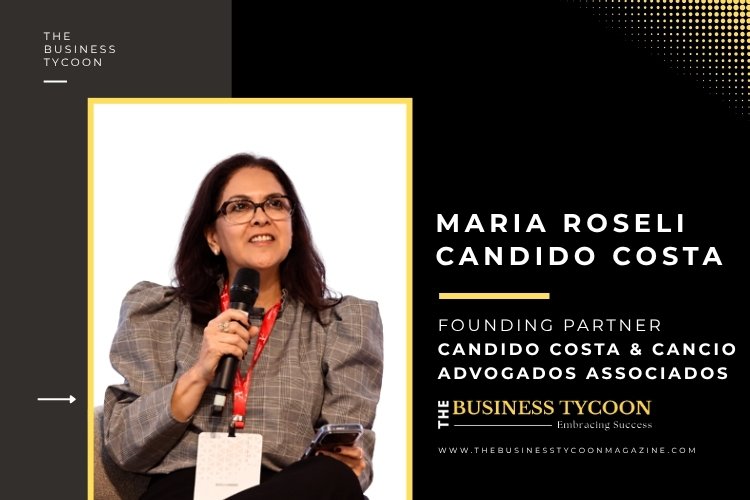
Beyond the Dispute: Maria Roseli Candido Costa and the Architecture of Strategic Legal Leadership
How Maria Roseli Candido Costa is redefining legal counsel through business insight, construction expertise, dispute prevention, and a commitment to continuous learning
In complex business environments, the most valuable legal advice often begins long before a dispute reaches a courtroom or arbitration tribunal. It begins with understanding the business itself: how a project is conceived, where risk is allocated, how contractual obligations are administered, how decisions are documented, and where seemingly minor operational issues can eventually become significant commercial conflicts. For Maria Roseli Candido Costa, Founding Partner at Candido Costa & Cancio Advogados Associados, this perspective has become the foundation of a professional philosophy built around sophisticated legal advice that understands business before it discusses law.
Her career has developed at the intersection of construction, infrastructure, complex contracts, claims management, dispute resolution, arbitration, education, and corporate training. Rather than viewing these disciplines as separate professional activities, Costa sees them as interconnected parts of a broader ecosystem of knowledge.Her work as counsel informs her teaching; teaching, in turn, challenges and refines her legal reasoning.At the same time, her experience as an arbitrator and participant in dispute-resolution institutions gives her an alternative perspective on how disagreements evolve and, importantly, how many of them could have been prevented.
At the heart of her approach is a simple but consequential idea: legal excellence is not merely about responding effectively when conflict arrives. It is about helping organizations make better decisions before conflict becomes inevitable.
Where Law Meets the Reality of Business
Candido Costa & Cancio Advogados Associados was created with a clear purpose: to provide sophisticated legal advice grounded in an understanding of the commercial and operational realities behind every matter. Over the years, the firm has developed a strong specialization in construction, infrastructure, complex contracts, claims management, and dispute resolution, sectors where legal interpretation alone rarely provides the complete picture.
Construction and infrastructure projects bring together multiple disciplines, contractual relationships, financial commitments, technical specifications, schedules, suppliers, engineers, project managers, investors, and numerous other stakeholders. Within such environments, a lawyer must understand more than the wording of an agreement. They must appreciate how the project operates and how contractual obligations interact with the practical realities of execution.
This philosophy informs the firm’s involvement throughout the contractual lifecycle. Its work extends from contract structuring and risk allocation to contract administration, change orders, claims and counterclaims, negotiations, mediation, dispute boards, arbitration, and litigation. The objective is not simply to intervene when a problem has become legally visible, but to understand the chain of decisions and circumstances that created it.
For Costa, this requires a multidisciplinary mindset. A strong claim, for example, is not constructed through legal arguments alone. It requires contemporaneous documentation, technical evidence, causation, quantification, and a coherent narrative connecting contractual rights to actual project events. That understanding has become a defining characteristic of her professional approach.
Building Authority Through Preparation
Entering and establishing authority within technically complex industries presents its own challenges. Construction and infrastructure have traditionally been environments heavily populated by technical professionals and historically characterized by strong male representation. For a legal professional, credibility in such settings cannot simply be claimed. It must be demonstrated through preparation, consistency, and a willingness to learn continuously.
Costa’s experience reflects this reality. Lawyers advising construction companies must be comfortable sitting alongside engineers, project managers, planners, executives, financial experts, and technical consultants. They must understand the language of the project as well as the language of the law.
In Costa’s view, that credibility is never a finished achievement. It is continually earned through the quality of preparation and the ability to engage meaningfully with different areas of expertise. Her career illustrates an approach to professional authority based not on occupying the loudest position in the room, but on being sufficiently prepared to contribute when the most difficult questions arise.
This philosophy also shaped how she viewed the traditional role of lawyers in construction disputes. Too often, organizations approached legal counsel only after a disagreement had become a formal conflict. Costa recognized that by that point, valuable opportunities for prevention may already have disappeared.
Many disputes begin much earlier. A scope change may not be properly documented. A contractual notice may not be issued on time. Project records may be incomplete. Responsibilities may gradually become unclear. Difficult conversations may be postponed until positions harden. Each of these seemingly operational issues can eventually become part of a much larger dispute.
For Costa, the most valuable legal work can therefore happen before anyone begins discussing litigation or arbitration.
The Power of Specialization
No single dramatic turning point drove the growth of Candido Costa & Cancio Advogados Associados. Instead, it emerged through specialization and the gradual recognition of the firm’s distinctive approach.
As clients increasingly understood that the firm’s work went beyond contract interpretation, its reputation developed around a deeper capability: understanding the architecture of complex disputes.
That distinction matters in construction and infrastructure.A well-founded claim must establish more than a contractual position.It must demonstrate what happened, why it happened, how it affected the project, what contractual mechanisms apply, and how the resulting consequences can be substantiated.
The firm’s growing focus on construction claims, contract administration, and complex disputes made its expertise more visible in the market. In specialized professional services, reputation often develops through repeated encounters. Clients recommend professionals to other clients. Engineers refer lawyers they trust. Experts and executives meet again across different projects. Professional relationships become cumulative.
Costa’s academic activities and involvement in arbitration and dispute-resolution institutions have further strengthened this ecosystem of expertise. Her philosophy is that professional knowledge becomes particularly valuable when the market associates that knowledge with a specific category of difficult problems.
For her, that is the essence of meaningful specialization: becoming the professional people seek when complexity demands more than a conventional answer.
Consistency, Independence, and Professional Judgment
Long-standing professional success, however, requires more than technical specialization. Costa identifies consistency as one of the most important foundations of trust.
Clients need to know that the quality of professional judgment will remain stable regardless of the size of the case or the convenience of the answer. This principle is closely connected to independence.
A lawyer’s responsibility is not to validate every position a client wishes to adopt. Sometimes professional integrity requires explaining that a claim is weak, that the evidence is insufficient, or that settlement may be commercially smarter than continuing a dispute.
Such conversations may not always be easy, but they can become the foundation of long-term professional relationships. Trust develops when clients know that their advisers are willing to provide an honest assessment rather than simply confirm what they would prefer to hear.
Costa combines this independence with intellectual curiosity. Construction and infrastructure are inherently multidisciplinary fields, connecting contracts with engineering, scheduling, procurement, finance, project management, governance, and human behavior.
Remaining relevant, therefore, requires continuous learning. Experience provides perspective, but experience without curiosity can eventually become rigidity. For Costa, professional expertise must remain open to new information, new technologies, new contractual models, and new ways of understanding complex business environments.
Leadership in an Age of Complexity
The modern leadership environment presents a different kind of challenge. Leaders have access to unprecedented volumes of information and are often expected to make decisions at ever-faster speeds. Yet speed does not automatically create better judgment.
Costa believes one critical leadership competency today is the ability to distinguish urgency from importance.
Economic uncertainty, technology, regulatory developments, geopolitical changes, and evolving workforce expectations increasingly intersect. Leaders must therefore combine analytical discipline with adaptability. They must process complexity without becoming paralyzed and respond to change without abandoning strategic judgment.
Conflict management is another essential component of effective leadership. Conflict itself is not necessarily destructive. Constructive disagreement can challenge assumptions and improve decision-making. Problems emerge when organizations fail to manage disagreement early, letting positions harden and relationships deteriorate.
Clear governance, defined responsibilities, transparent communication, and early intervention can help organizations prevent disagreements from becoming destructive disputes.
Costa also highlights a less visible leadership challenge: protecting the ability to think. A calendar dominated by meetings and constant responsiveness can create the appearance of productivity while leaving little space for reflection. In increasingly complex environments, leaders need time to examine information, question assumptions, consider consequences, and make deliberate decisions.
Innovation Begins With Better Questions
For Costa, innovation does not necessarily mean creating an entirely new product or transforming a traditional law firm into a technology company. It can begin with something much simpler and more powerful: asking better questions.
Why is this being done this way? Could the analysis be improved? Is important information being overlooked? Can technology help identify patterns more efficiently?
This questioning mindset encourages continuous improvement within professional teams. In complex legal matters, innovation can mean improving the quality, organization, and speed of thinking rather than simply introducing a new tool.
Interdisciplinary learning plays an important role in this process. Professionals working on construction disputes need to understand engineering concepts, project schedules, cost structures, project records, and contractual mechanisms. The strongest legal analysis often emerges when these different dimensions are considered together.
Costa’s experience in education has reinforced this philosophy. Teaching experienced professionals requires more than knowing what a rule says. It requires understanding why the rule matters, how it operates in practice, and how it connects to the broader project environment.
Her role as Coordinator of the MBA Construction Claims Specialist at PUC Minas represents this commitment to developing multidisciplinary expertise. Construction claims require knowledge across law, engineering, project management, finance, and dispute resolution. Bringing these disciplines together prepares professionals for projects whose complexity increasingly exceeds the boundaries of a single profession.
The Human Judgment Behind Artificial Intelligence
Technology is also transforming the legal profession. Complex construction disputes can involve thousands of documents, contractual communications, schedules, reports, technical records, and financial data. Digital tools can improve how teams organize and analyze this information, enabling multidisciplinary teams to collaborate more efficiently across locations.
Artificial intelligence introduces another significant layer of opportunity. It can assist with document review, legal research, information organization, and identifying relationships across large datasets. In legal practice, however, its use must also be accompanied by careful attention to confidentiality, professional secrecy, data governance, and independent verification of outputs.
Yet Costa sees an important distinction between technological capability and professional judgment.
AI may help professionals process information, but clients ultimately require more than information. They need someone who can understand what the information means, identify the risks it creates, weigh competing considerations, and decide what should follow.
Accountability remains human.
The future of legal practice, therefore, may not belong simply to professionals who adopt AI tools. It will increasingly belong to those who understand how to ask the right questions, verify outputs critically, recognize limitations, and determine where human judgment remains indispensable.
Redefining the Lawyer’s Role
Costa does not describe Candido Costa & Cancio Advogados Associados as a technology platform. Instead, the firm’s contribution lies in challenging a traditional professional model.
The conventional approach often positions lawyers as specialists who become involved only after a problem has developed into a dispute. Costa’s philosophy moves that intervention earlier.
The contract should not be treated merely as a document to be interpreted when something goes wrong. It can also function as a management tool.
This means legal professionals can get involved earlier by helping organizations understand risks, monitor contractual procedures, strengthen documentation, and identify potential disputes and, when disputes do arise, manage them more effectively.
In construction, this difference can be decisive. A claim supported by contemporaneous documentation is fundamentally different from a claim reconstructed years after the relevant events.
This is why Costa sees prevention and dispute resolution as interconnected, not separate, disciplines. Prevention is, in many ways, the first stage of dispute resolution.
Leadership Through Diversity and Perspective
Costa’s professional journey has also shaped her perspective on diversity, equity, and inclusion. Having spent much of her career in environments involving construction, infrastructure, engineering, contracts, and disputes, she has experienced sectors historically characterized by strong male representation.
Her perspective is grounded in the belief that professional recognition is built through competence, persistence, and presence. At the same time, she emphasizes that women should not have to imitate traditional leadership models to be respected.
Multiple legitimate ways to lead exist.
For Costa, diversity also extends beyond gender. Different generations, professional backgrounds, cultural experiences, and approaches to problem-solving can strengthen decision-making. An organization becomes more resilient when people can disagree intelligently without fearing that disagreement will exclude them from the conversation.
This idea closely mirrors her philosophy of dispute management: disagreement itself is not necessarily the problem. The way an organization responds to disagreement determines whether it becomes constructive or destructive.
Expansion Through Knowledge and Influence
One of the most meaningful developments in Costa’s professional journey has been expanding her work across professional practice, dispute resolution, and education.
Her role as an arbitrator and her involvement with dispute boards and dispute-resolution institutions have broadened her perspective beyond advocacy. As counsel, the professional develops and presents arguments on behalf of a party. As a neutral, the professional must evaluate arguments from a different position.
The intellectual exercises are distinct, yet complementary.
This broader perspective strengthens her understanding of how disputes are constructed and how decision-makers evaluate evidence, arguments, causation, and contractual rights. At the same time, her academic work creates an opportunity to transfer this knowledge to the next generation of professionals.
For Costa, this is what meaningful professional expansion looks like. It is not simply becoming larger. It is becoming more relevant.
The Future Is Built Before It Arrives
Maria Roseli Candido Costa’s professional philosophy ultimately returns to a principle that has guided her work across legal practice, arbitration, education, and corporate advisory services: understand complexity before it becomes conflict.
In construction and infrastructure, projects rarely fail because of a single isolated event. Difficulties emerge through interconnected decisions, documentation gaps, contractual ambiguities, communication failures, technical challenges, and commercial pressures. Addressing these issues effectively requires professionals who can see the entire picture.
That is the role Costa continues to pursue.
Her approach combines legal knowledge with commercial awareness, technical curiosity with professional independence, counsel with neutrality, and experience with continuous learning.It also reflects an evolving understanding of what clients should expect from sophisticated legal counsel.
The modern legal adviser is not simply a responder to disputes. The adviser can be a strategic participant in a project’s life, helping organizations understand risk, strengthen governance, improve contract administration, and make informed decisions before problems become irreversible.
For Costa, professional growth is therefore not limited to a firm’s size or the number of matters handled. It is reflected in whether knowledge has become trusted enough that people seek you when the problem is difficult.
That trust is built slowly, through consistency, independence, preparation, learning, and the courage to ask better questions.
And perhaps that is the most enduring lesson of her journey: the strongest legal strategy does not always begin with preparing for the dispute. Sometimes, it begins with understanding how to prevent the dispute from becoming inevitable.