
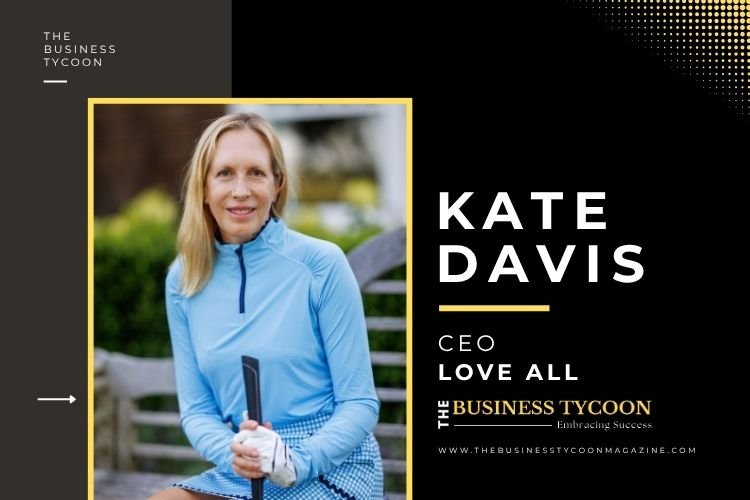
From Love All to Every Court, Course & Community
How Kate Davis is redefining sportswear through style, inclusivity, and a belief that everyone deserves a place in the game
There is a certain kind of brand that sells clothing. And then there are brands that sell a feeling.
For Kate Davis, Founder & CEO, Love All, that feeling is one of confidence, belonging, and joy. Built around the simple belief that sport should feel welcoming, stylish, and accessible to everyone, Love All has evolved from a tennis-focused concept into a growing family of inclusive sports and lifestyle brands spanning tennis, golf, swim, ski, pickleball, lifestyle, children’s apparel, and menswear.
At the heart of the business is an idea that is both deceptively simple and remarkably powerful: everyone deserves to feel invited into the game.
Davis calls the brand’s aesthetic “retro chic, performance peak,” a philosophy that brings together the elegance and optimism of vintage sportswear with modern technical fabrics, contemporary fits, and real functionality. The result is apparel designed not only for the court, course, or mountain, but for everything that happens afterward. It is this intersection of performance, design, lifestyle, and community that has become Love All’s defining identity.
But the journey toward building that identity began long before Love All.
Davis arrived at the company with years of entrepreneurial experience behind her. Her first venture, Pickett’s Press, grew from a business plan she developed at Harvard Business School into a luxury stationery brand. She later founded Davis Designs, an interiors and e-commerce business. Each chapter taught her something different about building a company, understanding customers, developing products, and navigating the unpredictable nature of entrepreneurship.
Love All brought those lessons together. “Love All brings together so much of what I learned from those businesses: the importance of product, branding, customer relationships, design, technology and, perhaps most importantly, perseverance,” Davis explains.
Turning a Creative Vision into a Business
The early days of Love All were shaped by the challenge of transforming a compelling creative idea into a business capable of growing at scale. From the outside, apparel can appear relatively simple, but building a successful fashion and performance brand requires a complex network of decisions and operations working seamlessly together. Every garment involves considerations around design, fit, technical fabrics, manufacturing, minimum order quantities, inventory, logistics, e-commerce, wholesale, marketing, and retail. For Davis, the lesson was clear from the beginning: a beautiful product is only one part of building a successful brand. “A beautiful product alone is not enough,” she says. “All of those pieces need to work together.”
That challenge became even more significant as Love All entered an increasingly crowded athletic apparel marketplace. Creating another collection of sportswear was never the ambition. The company needed to establish a distinctive identity that customers could recognize immediately and connect with emotionally. For Davis, that meant bringing together elements that are not always associated with one another, performance and nostalgia, femininity and functionality, style and inclusivity. The result was a brand designed to feel both elevated and approachable, offering technical performance without losing the personality and elegance that make the clothing distinctive.
At the center of that vision was a desire to make sport feel more welcoming. Love All was never created exclusively for elite athletes or those who had spent their lives competing. Instead, Davis wanted the brand to speak equally to the lifelong player and the person picking up a racket for the very first time. The name itself captures that philosophy. In tennis, “love all” represents the beginning of a match, a moment when everyone starts from the same place. For Davis, that simple expression carried a much deeper meaning.
Many sports have historically been perceived as intimidating or exclusive, particularly by people who did not grow up playing them or who did not have access to certain clubs, communities, or opportunities. Love All seeks to challenge that perception by creating a sense of invitation rather than intimidation. The message is not about who is the most experienced, the most competitive, or the most skilled. It is about creating a space where everyone can participate and feel confident doing so. As Davis puts it, “You do not need to be the best player in the room to belong.”
That belief has become far more than a brand message. It is woven into the company’s identity, its product philosophy, its approach to community, and its vision for the future. Love All is ultimately built around the idea that sport should not be defined by barriers, it should be a place where people can discover confidence, connection, and joy. By transforming that belief into a brand, Davis has created a company that is not simply selling performance apparel, but inviting more people to see themselves as part of the game.
The Moment Love All Became Bigger Than Tennis
A pivotal moment in Love All’s evolution came when Kate Davis and her team realized that customers were responding to something much larger than tennis apparel. They were drawn not only to the performance of the products, but also to the aesthetic, attitude, and lifestyle the brand represented. That realization opened the door to a much broader vision for Love All, one that could extend naturally across different sports, generations, and everyday experiences without losing the identity that had made the brand distinctive in the first place.
From that point, Love All began expanding into golf, swim, ski, pickleball, and lifestyle categories, while also introducing Love All Littles for children and Forty Love for men. The evolution represented more than simply adding new products to the collection. It marked a shift from being a tennis-focused apparel company to creating an entire world around sport and style. Each new category offered an opportunity to reinterpret the Love All aesthetic while staying true to the same principles of performance, confidence, inclusivity, and polished design.
The opening of the company’s New York flagship became another important milestone in that journey, giving customers an opportunity to experience the Love All world beyond a screen. At the same time, the brand continued expanding through e-commerce, marketplaces, wholesale relationships, club shops, and pop-ups, creating multiple ways for customers to discover and interact with the collection. Davis and her team have also taken the brand directly into the communities where their customers live and play, hosting events and activations in destinations such as Nantucket, East Hampton, and Montauk, as well as participating in tennis and golf industry events in Florida.
For Davis, however, these experiences offer something that digital data alone can never fully capture. Being physically present with customers allows her team to observe what people are naturally drawn to, what they try on, what they purchase, and how they respond to the brand in real time. “Nothing replaces talking directly to customers and watching what they actually pick up, try on and purchase,” she says. Those conversations have become an important source of insight as Love All continues to evolve.
Rather than assuming it already knows what customers want, the company remains committed to watching, listening, testing, and adapting. Every interaction becomes another opportunity to learn, refine, and understand where the brand can go next. In many ways, that willingness to stay close to the customer has helped transform Love All from a tennis apparel concept into a growing lifestyle movement, one that continues to expand while keeping its original sense of connection at the heart of everything it does.
Performance That Doesn’t End at the Court
One of Love All’s strongest differentiators lies in its understanding of how modern consumers actually live. Today’s customer does not necessarily divide her day into neatly separated moments that require a different outfit for each one. She may begin the morning on the tennis court, stop for coffee afterward, meet friends for lunch, run errands, and eventually head to a family gathering, all without wanting to completely change her wardrobe along the way. Love All recognized this shift and built its product philosophy around the idea that performance apparel should be able to move naturally with the customer beyond the boundaries of sport.
That insight is reflected throughout the brand’s growing collection, which includes dresses, skirts, skorts, tops, jackets, sweaters, swimwear, outerwear, accessories, and coordinated sets. Matching pieces have become an important part of the offering, giving customers the flexibility to create complete looks while mixing and matching according to their individual style. The adult-and-child collections add another dimension to the concept, allowing families to share the aesthetic and experience of Love All in a way that feels playful, polished, and connected.
The philosophy comes to life through expressions such as “Court to Café” and “Fairway to Family Dinner,” capturing the brand’s belief that sportswear should not be confined to the moments when an individual is actively competing. Performance apparel can be technical enough for the court or course while remaining stylish enough for everything that follows. Likewise, fashion should not require customers to compromise on comfort, movement, or functionality simply to look polished.
That balance has become central to Love All’s identity. The brand draws inspiration from the past, particularly the elegance and optimism of vintage sportswear, but interprets those influences through a contemporary lens. Optimistic colors, feminine silhouettes, polished details, and nostalgic references create the visual character, while modern fabrics, thoughtful fits, and performance-driven functionality ensure the clothing meets the expectations of today’s customer. It is this meeting point between heritage and innovation, sport and lifestyle, performance and style, that gives Love All its distinctive place in the modern apparel landscape.
Technology as a Conversation, Not Just a Tool
Technology has become an important part of Love All’s growth, helping the company expand its reach while maintaining the close connection with customers that has always been central to its philosophy. Today, customers can discover the brand through a wide range of touchpoints, from influencers and Instagram to Google searches, marketplaces, club shops, pop-ups, and physical retail, before continuing their journey through the company’s e-commerce platform. Rather than existing as separate channels, these touchpoints work together to create a connected brand experience that allows customers to move naturally between discovery, exploration, and purchase.
The e-commerce operation is supported by technology across inventory management, email marketing, customer segmentation, digital advertising, influencer marketing, and fulfillment. Email marketing platforms allow the company to communicate with customers based on their individual interests and behaviors rather than delivering the same message to everyone. Influencer and affiliate platforms similarly help Love All identify creators whose audiences genuinely align with the brand, creating more authentic connections between the company and potential customers.
Yet for Davis, perhaps the greatest advantage technology provides is not simply reach, it is speed. A growing company can now receive immediate insight into customer behavior, understanding which products are attracting attention, what is converting, what customers are searching for, and which categories are beginning to gain momentum. That continuous stream of information gives Love All the ability to make decisions faster, test ideas more efficiently, and respond to changing customer preferences without relying solely on traditional, slower feedback cycles.
Importantly, Davis does not see technology as a replacement for human connection. Instead, she views it as an extension of that relationship. The modern customer is no longer simply positioned at the end of a traditional supply chain, waiting to receive a finished product. Through social media, e-commerce, retail, pop-ups, and direct communication, customers can participate in the brand conversation throughout the journey. They can influence what gets noticed, what gets purchased, and ultimately what the company creates next. For Love All, that ongoing relationship is more than a technological advantage, it is a competitive strength that keeps the brand connected to the people at the heart of its growth.
Leading Through Change
Kate Davis’s leadership philosophy has been shaped by years of entrepreneurship, with each chapter teaching her the importance of knowing what should remain constant and what must be allowed to evolve. Perhaps one of the most important lessons she has carried into Love All is the distinction between vision and tactics. “The vision should remain relatively constant. Your tactics should be allowed to change constantly,” she explains. For Davis, that balance has become increasingly important in a business environment defined by rapid technological change, evolving consumer expectations, and an increasingly fragmented media landscape.
Today’s leaders have access to more information, platforms, technologies, and opportunities than ever before. While that abundance can create tremendous possibilities, it can also make decision-making more complicated. There is always another trend to follow, another platform to explore, or another strategy promising growth. The temptation is to chase every new idea or, alternatively, become overwhelmed by the number of choices. Davis believes effective leadership requires the ability to separate what truly matters from the noise. Rather than constantly changing the destination, leaders should remain clear about the larger vision while staying flexible about how they reach it.
That flexibility is closely connected to resilience. Entrepreneurship rarely follows a perfectly predictable path. Manufacturers experience delays, marketing strategies lose their effectiveness, customer preferences shift, and plans inevitably change. Davis has learned through experience that setbacks are not necessarily signs that a larger vision is failing. Sometimes they are simply part of the process of building something new. “A problem that feels overwhelming on Monday can become almost irrelevant by Friday if you keep moving,” she says. Her approach is therefore grounded not in avoiding uncertainty, but in developing the confidence to work through it without losing momentum.
For Davis, however, adaptability is only one part of effective leadership. Staying close to the people who shape the business is equally important. Customers and employees can offer perspectives that numbers and analytics cannot always capture. Data can reveal what is happening, but conversations and observation can often reveal why. Davis believes leaders need to ask questions, listen carefully, and remain genuinely connected to the people they serve and the people they work alongside. For her, listening is not simply a leadership quality, it is an essential part of building a business that can continue to evolve without losing sight of the people at its center.
Creating a Culture Where Ideas Can Move
Inside Love All, Kate Davis fosters an entrepreneurial culture where people are encouraged to think boldly, share ideas, and feel empowered to experiment. The company continually explores new marketing platforms, retail channels, product categories, collaborations, and technologies, recognizing that not every experiment will succeed, and that failure can be just as valuable as success when it creates an opportunity to learn and improve. For Davis, the goal is not to get every decision right the first time, but to move quickly, understand what works, and carry those lessons forward.
Collaboration is equally important to that culture. Love All operates across interconnected functions, and Davis believes that information should move freely between them. The e-commerce team needs to understand what is happening in retail, marketing needs to hear directly from wholesale customers, and designers need feedback from sales and the people interacting with customers every day. When these perspectives come together, the company gains a more complete understanding of its customers and can make stronger, faster decisions.
Davis also sees technology as one of the greatest opportunities available to modern entrepreneurs. She encourages her team to become increasingly fluent in emerging technologies, particularly artificial intelligence, digital marketing, and e-commerce tools. Technology has significantly reduced the barriers to accessing capabilities that once required large teams and substantial budgets, giving smaller and more agile businesses the ability to compete, experiment, and scale in entirely new ways. For Davis, the companies most prepared to embrace this opportunity will be those willing to remain curious, keep learning, and adapt as quickly as the world around them changes.
Love All Means More Than Apparel
The inclusive philosophy behind Love All extends far beyond the products it creates. Through Love All Loves All, the company’s nonprofit initiative, Kate Davis directs a portion of profits toward programs that enrich children’s lives through sport within their communities. The initiative reflects a belief that sport can be about so much more than competition or physical activity. It can build confidence, create friendships, teach discipline, develop resilience, and give young people a genuine sense of belonging. For Davis, making those experiences more accessible is not simply a corporate responsibility initiative, it is a natural extension of what Love All represents.
That same philosophy is reflected within the company itself. Davis believes that diversity and inclusion create stronger, more creative organizations because people bring different experiences, perspectives, and ways of thinking to the table. She encourages individuals of different ages, backgrounds, and life experiences to contribute their ideas and play an active role in shaping the business. For Love All, inclusion is therefore not simply a message communicated to customers; it is a value woven into the company’s culture and its vision for the future. Ultimately, Davis wants Love All to stand for a simple idea: everyone should have the opportunity to participate, contribute, feel confident, and know that they belong.
Building the Next Chapter
Perhaps the most exciting part of Love All’s story is that the company is still writing its early chapters. What began with a clear vision for tennis has evolved into something far broader, a growing family of sports and lifestyle brands designed to move seamlessly across sports, generations, and everyday life. The expansion into golf, swim, and Love All Littles is not simply about adding new categories to a product portfolio; it reflects the strength of a brand that has discovered an emotional connection with customers beyond any single sport. At the heart of that evolution is a question Kate Davis and her team return to whenever they enter a new category: rather than asking what every other golf or swim brand looks like, they ask, “What would Love All look like if we took it to the golf course or the beach?” That distinction allows the company to expand while remaining unmistakably itself.
As Love All continues to grow, maintaining that balance will be essential: expanding without becoming diluted, embracing innovation without losing its heritage, and reaching new customers without sacrificing the personal connection that has helped shape the brand. For Davis, the answer lies in staying curious and remaining close to the customer. She continues to observe how people shop, what they wear, where they spend their time, how cultural preferences evolve, and where new opportunities may emerge. She believes that innovation does not always require creating something that has never existed before. Sometimes, it means taking something familiar and beloved and reimagining it for a new generation.
That philosophy may ultimately be one of Love All’s greatest strengths. The brand takes the nostalgia, elegance, optimism, and community associated with classic sportswear and translates those qualities into a modern world, one where performance and personality can exist together, where clothing designed for the court or course can effortlessly become part of everyday life, and where feeling confident and included matters just as much as performance. From tennis courts and golf courses to beaches and ski mountains, and from adults to children, Love All is creating more than a collection of apparel. It is building a world around a simple but powerful belief: everyone deserves to feel welcome in the game.
For Kate Davis, the next chapter isn’t about deciding who gets invited. It is about opening the door wider.