
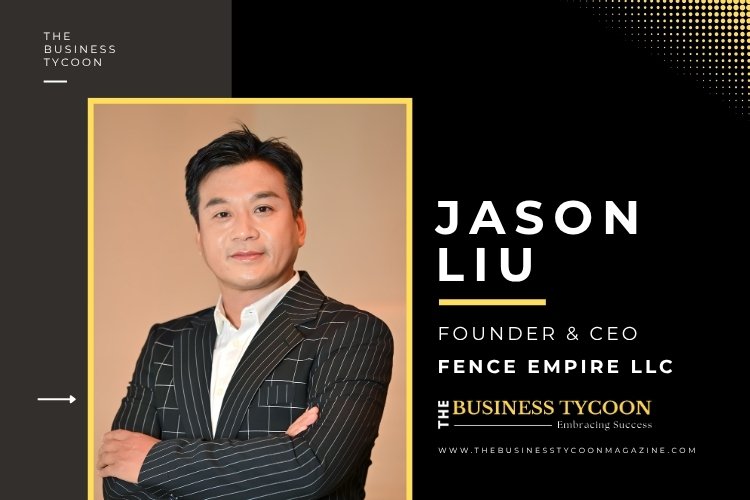
From Manufacturing Heritage to Supply-Chain Leadership: Jason Liu Is Building the Future of America’s Fencing Industry
A Legacy of Manufacturing, A Vision for Reliability
In an industry where consistency, supply security, and trust can determine the success of a project, Jason Liu is taking a different approach to leadership. As Founder and CEO of Fence Empire LLC, Liu is building more than a supplier of fencing and building materials. He is creating an integrated supply system designed to give customers greater confidence in an increasingly unpredictable global marketplace.
The foundation of Fence Empire’s philosophy can be traced back more than three generations. Liu’s family manufacturing heritage began with sawmill operations in 1952, creating a deep understanding of raw materials, production, quality, and the realities of manufacturing. Over time, that experience evolved into an international supply network connecting raw-material sourcing, manufacturing, logistics, and customers across multiple markets.
When Liu founded Fence Empire in the United States, his objective was straightforward but ambitious: create a supplier customers could depend on not only for competitive products and pricing, but also for consistency, transparency, and long-term supply security.
Today, Fence Empire serves wholesalers, distributors, building-material companies, large contractors, and franchise networks across the United States. Its portfolio includes wood fencing products, ornamental steel and aluminum fencing, railing systems, and other building materials.
Yet, for Liu, the company’s value extends far beyond the products it sells. “We are not simply selling products; we are building a supply system that our customers can confidently build their businesses around,” is a philosophy that captures the organization’s broader mission.
Earning Trust in a Mature Industry
Entering an established industry is rarely easy. Customers already have suppliers, purchasing processes, and long-standing commercial relationships. For a new company, offering a lower price is rarely enough to convince customers to change.
For Fence Empire, the earliest challenge was therefore one of trust. The company understood that credibility could not be created through promises alone. It had to be demonstrated shipment by shipment, order by order, and relationship by relationship.
At the same time, Liu recognized that building a reliable international supply chain required discipline. Raw-material availability, manufacturing capacity, ocean freight, tariffs, customs compliance, port congestion, transportation costs, and regulatory changes could all influence the ability to deliver on a commitment.
Rather than pursuing growth at any cost, Fence Empire focused on developing an operating system capable of supporting the commitments it made to customers. That strategy sometimes meant growing more deliberately, but it created a stronger foundation for sustainable expansion.
This philosophy became particularly important as global supply chains experienced unprecedented disruption. Freight volatility, tariffs, port congestion, inflation, geopolitical uncertainty, and increasing customs scrutiny demonstrated that the lowest purchase price does not always represent the lowest long-term cost. Customers began asking a more important question: who could continue supplying them when market conditions became difficult? Fence Empire had been preparing for precisely that expectation.
When a Vendor Becomes a Strategic Partner
Fence Empire’s defining growth moment did not arrive through a single transaction or customer. Instead, it emerged gradually as customers began viewing the company as a strategic supply partner rather than another vendor.
Repeat orders developed into referrals. Smaller relationships evolved into larger programs. Customers began trusting Fence Empire with more products, more locations, and more of their long-term purchasing plans. Trust became a growth engine. This evolution reflects Liu’s belief that successful business relationships should be measured beyond individual purchase orders. In an industry exposed to supply-chain uncertainty, customers need partners who understand the broader pressures affecting their businesses.
That is why consistency remains one of Fence Empire’s most important principles. Markets change. Freight rates fluctuate. Tariffs shift. Manufacturing conditions evolve. Regulations become more complex. Yet customers still have projects to complete, inventories to manage, and businesses to operate.
For Liu, leadership means doing everything reasonably possible to honor commitments despite those changing circumstances.
This commitment has shaped how Fence Empire approaches pricing, manufacturing, communication, customer service, and supplier relationships. Rather than treating every transaction as a negotiation over the last dollar, the company seeks to create relationships where manufacturers, logistics partners, employees, and customers have enough stability to invest in the future.
Redefining the Role of a Supplier
One of Fence Empire’s greatest differentiators is its direct factory-to-customer model. Traditional supply chains can involve numerous layers between the manufacturer and the final customer. Products may move from a factory to an exporter, importer, master distributor, regional distributor, and eventually the customer. While every layer can serve a purpose, additional complexity can also increase costs and reduce visibility.
Fence Empire seeks to shorten that chain. By remaining closely involved in manufacturing, sourcing, quality control, logistics, and product development, the company creates a closer connection between customers and qualified manufacturing partners.
This approach provides customers with greater visibility into production, specifications, quality, logistics, and long-term supply planning.
Liu describes the organization more accurately as a supply platform than a traditional distributor. The objective is not disruption simply for the sake of disruption. Instead, Fence Empire works to remove unnecessary inefficiencies while protecting customer relationships and maintaining the value of established channels. That balance is particularly important in the building-materials sector, where distributors, contractors, franchise networks, and manufacturers all depend on reliable commercial relationships.
Innovation Beyond the Product
For Fence Empire, innovation is not limited to launching a new product. It can be found in the way products are manufactured, inspected, packaged, shipped, communicated, and supported. Liu encourages his team to look beyond immediate symptoms and investigate problems at their source. A customer complaint, installation challenge, special request, or changing market preference can become valuable information when it is brought back into manufacturing and product development.
This creates a continuous feedback loop between customers and operations. Technology plays an increasingly important role in that process. Fence Empire does not position itself as a technology company, nor does it adopt technology simply because it is fashionable. Instead, the company focuses on practical applications that improve visibility, communication, accuracy, and decision-making.
Modern information and communication systems help coordinate production schedules, product specifications, quality-control information, shipping documentation, logistics status, and customer requirements across countries and time zones. The ultimate objective is simple: customers should have better visibility and fewer surprises.
Expanding Beyond Wood
While Fence Empire has strong roots in wood fencing and manufacturing, Liu recognizes that long-term competitiveness requires diversification. The company’s product portfolio includes Japanese cedar fence pickets, rails, posts, dimensional lumber, Tongue & Groove products, decking-related products, specialty wood components, ornamental steel and aluminum fencing systems, and aluminum railing.
One notable expansion has been the development of aluminum fencing and railing, including the AmeriRail product line. This expansion represents more than the addition of another category. It reflects Fence Empire’s broader strategy of developing manufacturing capabilities and diversifying its supply platform beyond its traditional strength in wood fencing.
The company approached the expansion from a manufacturing perspective rather than simply sourcing finished products from the open market. This gave Fence Empire greater involvement in specifications, production, quality, and long-term product development.
Most importantly, the organization listened to customers throughout the process. For Liu, successful product development begins with real market requirements rather than assumptions. Existing customer relationships provided an important foundation for entering new categories while the company’s manufacturing and supply-chain capabilities provided the infrastructure needed to support them.
The result reinforces an important principle: successful expansion should build on existing organizational strengths. For Fence Empire, those strengths are not tied to a single product. They are rooted in manufacturing knowledge, supply-chain management, customer relationships, and reliability.
Leading Through Uncertainty
Liu believes one of the greatest challenges facing modern leaders is making long-term decisions in an environment increasingly dominated by short-term uncertainty. Tariffs, regulations, technology, customer expectations, labor conditions, geopolitical developments, and supply-chain disruptions can change quickly. Leaders may feel pressured to react to every new development.
But constant reaction is not strategy. Liu advocates distinguishing temporary volatility from structural change. Organizations should build resilience before a crisis arrives rather than attempting to create it once disruption has already begun.
For supply-chain businesses, that means diversifying manufacturing sources, maintaining strong factory relationships, understanding compliance and regulatory risks, protecting cash flow, investing in people, and communicating honestly with customers. Equally important, leaders must recognize what should not change.
Technology may evolve. Markets may shift. Products may change. But principles such as integrity, reliability, accountability, and respect for long-term relationships can remain constant. These principles provide organizations with stability when external conditions are anything but stable.
Building a Culture of Respect and Learning
Fence Empire’s international operating environment naturally brings together people from different countries, cultures, professional backgrounds, and areas of expertise. Liu views this diversity as a practical business advantage.
When people with different experiences are encouraged to contribute, organizations gain access to perspectives that can challenge assumptions and improve decision-making. This is particularly important for an international supply-chain organization, where a strategy that works in one market or cultural environment may not necessarily work in another.
Fence Empire therefore emphasizes professionalism, integrity, effort, contribution, and respect. Employees should be able to express different viewpoints, raise concerns, and challenge existing assumptions constructively. The objective is not to eliminate disagreement, but to create an environment where thoughtful disagreement can lead to better decisions.
This philosophy also connects directly with continuous learning. Problems are not simply issues to be hidden; they are opportunities to understand where a process can improve.
The Next Chapter of Fence Empire
Looking ahead, Jason Liu is not focused solely on making Fence Empire a larger company. His ambition is to make it a stronger and more valuable partner to the fence and building-materials industries.
The future of supply is likely to be defined by resilience as much as by price. Companies will increasingly need diversified sourcing, stronger manufacturing relationships, better visibility, flexible logistics, and reliable partners capable of navigating uncertainty. Fence Empire is positioning itself around that future.
Its evolution from manufacturing heritage to an integrated supply-chain model demonstrates how traditional industry knowledge can become a foundation for modern business transformation. The company is combining decades of manufacturing understanding with international sourcing, supply-chain management, customer collaboration, technology-enabled communication, and product diversification.
At the center of that evolution is Jason Liu’s belief that sustainable success is created through trust. The company’s story is ultimately not about selling fence products. It is about understanding what customers need to build their own businesses with confidence.
In a world where supply chains can change overnight, and uncertainty can become a competitive challenge, reliability becomes a strategic advantage. Jason Liu and Fence Empire are building around that advantage, creating a model in which manufacturing expertise, operational discipline, innovation, and long-term relationships come together to redefine what a modern supplier can be.
For Fence Empire, the next generation of industry leadership will not simply be measured by how much a company sells. It will be measured by how effectively it helps customers navigate uncertainty, manage growth, and build for what comes next. That is the supply system Jason Liu set out to build. And it is the future of Fence Empire he continues to shape.