
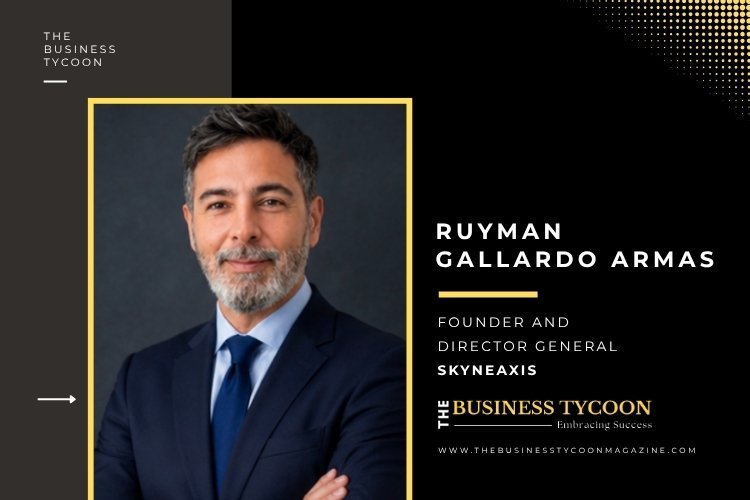
Beyond Consulting: How Ruyman Gallardo Armas Is Reengineering Aviation Performance Through Skyneaxis
The aviation industry has never been one-dimensional. An airline may have a strong commercial strategy, but if aircraft availability is weak, revenue suffers. A procurement decision may appear financially attractive, yet a delayed component can ground an aircraft and create a much higher operational cost. Fleet expansion may promise growth, but without the right maintenance capabilities, supplier network, technical infrastructure, people and operating model, that growth can quickly become a liability.
For Ruyman Gallardo Armas, Founder and Director General of Skyneaxis, this interconnectedness represents both one of aviation’s greatest challenges and one of its biggest opportunities.
With more than two decades of experience spanning consulting, aerospace and aviation, including professional experience with Accenture, Honeywell, IAG, Qatar Airways and SAUDIA, Ruyman built Skyneaxis around a clear conviction: aviation businesses do not need more presentations about problems they already understand. They need experienced people who can connect strategy with execution and take responsibility for measurable outcomes.
Skyneaxis was created to do exactly that.
From Aviation Ambition to Measurable Performance
The foundation of Skyneaxis is deliberately different from the traditional consulting model. Rather than beginning with a large project team, lengthy diagnostic process and standardised methodology, the company begins with a fundamental question: What result does the business need to achieve?
From there, Skyneaxis builds the capabilities required to deliver it.
The company works across airline transformation, procurement, supply-chain performance, aircraft availability, maintenance, technical performance, commercial development and broader business transformation. Its approach is supported by a global ecosystem of specialist companies and aviation experts, enabling Skyneaxis to assemble the right combination of expertise for each challenge.
This model allows the organisation to remain lean while providing access to highly specialised capabilities.
Ruyman believes that aviation problems rarely remain within one department. A supply-chain issue can become an aircraft availability problem. Aircraft availability can become a network disruption. Network disruption can affect revenue, customer experience and financial performance.
Therefore, solving the original problem requires understanding the entire chain of consequences.
This integrated philosophy is particularly relevant for growing airlines, new aviation ventures, MROs and specialised aviation businesses. While established carriers may require speed and specialist expertise, emerging operators often need access to capabilities that would otherwise take years to develop internally.
For Skyneaxis, growth should not simply mean adding aircraft or expanding operations. It should mean building the organisational, technical and commercial foundations capable of supporting sustainable expansion.
Building a Different Kind of Aviation Partner
One of the earliest challenges for Skyneaxis was differentiation.
The aviation industry already has numerous consulting organisations, and Ruyman had no intention of creating another conventional consultancy. From the beginning, Skyneaxis needed to represent something distinct: senior experience, direct accountability and execution.
That principle shaped the company’s ecosystem.
Instead of attempting to build every capability internally, Skyneaxis developed relationships across digital procurement and sourcing, aviation financing, aeronautical parts and components, aircraft technical services, asset transitions, continuing airworthiness, technical records, structural integrity, maintenance support, specialised aviation products and executive transformation.
The objective is not to accumulate partners or logos. The value comes from knowing how to combine the right capabilities around a specific business problem.
The model also provides access to former C-level aviation executives who can work directly with CEOs, Boards and leadership teams on transformation, restructuring, operational performance and commercial strategy.
For Ruyman, this is where Skyneaxis began to demonstrate its potential as more than an advisory firm. The market started recognising the company as a platform capable of bringing together senior leadership, specialist expertise and execution around complex aviation challenges.
Opportunities across Europe, the Middle East, Africa and Central Asia further validated the model.
Established airlines are looking for faster access to specialised capabilities, while growing operators need experience and infrastructure without having to build everything themselves. Skyneaxis sits between those two needs, providing flexibility without sacrificing seniority or accountability.
Growth Measured by Trust, Not Headcount
Ruyman has a deliberately unconventional definition of growth.
For him, growth is not primarily measured by the number of employees, offices or countries represented on a corporate map. It is measured by the size and strategic importance of the problems clients trust the company to solve.
That philosophy is particularly important because Skyneaxis is still a young organisation. Ruyman is transparent about that fact. The company itself does not have decades of history, but the experience behind it does.
More than twenty years across consulting, aerospace and aviation have provided the judgement on which the business is built.
Those years also reinforced a fundamental leadership lesson: organisations destroy value when individual functions optimise themselves instead of optimising the company.
A procurement department can reduce purchasing costs while creating operational risk. A maintenance team can improve its own metrics while affecting network performance. Finance can focus on immediate cost reduction while overlooking the long-term impact on reliability.
The company must therefore be viewed as one integrated system.
This thinking forms the foundation of Skyneaxis’ approach. Its role is not simply to identify an isolated problem but to understand the economic and operational consequences surrounding it.
Leadership in an Era of Colliding Risks
Today’s aviation leaders face a challenge that goes beyond uncertainty. Uncertainty has always been part of leadership. What has changed is the speed at which multiple risks can collide.
Inflation, geopolitical instability, supply-chain disruption, talent shortages, technology changes and evolving customer expectations can now influence one another almost simultaneously.
In aviation, the consequences can be immediate.
A single unavailable component, engine issue, maintenance delay or supplier failure can remove an aircraft from the schedule and begin affecting revenue within hours.
Ruyman believes leaders need five fundamental capabilities to navigate this environment.
Clarity comes first. Organisations with twenty priorities effectively have none. Teams need to understand what matters, why it matters and what result is expected.
Speed is equally important. Perfect information rarely exists. Effective leaders make informed decisions with the information available and remain willing to adjust when conditions change.
Cross-functional accountability follows. Procurement, maintenance, finance, operations and commercial teams cannot operate as isolated entities. The business succeeds or fails collectively.
Talent is another critical factor. Strong leaders build teams capable of making decisions rather than creating organisations where every decision must move upward.
Finally, leaders need proximity to execution.
Ruyman has consistently moved between the boardroom and the operation. His philosophy is straightforward: understanding the presentation is not the same as understanding the business.
Leaders need visibility into the hangar, warehouse, AOG desk, supplier network and customer journey because that is where strategy ultimately becomes reality.
Innovation Starts With a Better Question
At Skyneaxis, innovation is not treated as a slogan or a technology budget.
Instead, it begins with a simple question: Why are we doing it this way?
If the only answer is that the organisation has always operated that way, there may already be an opportunity for improvement.
Ruyman believes some of the most meaningful improvements do not necessarily come from expensive transformation programmes. They can emerge when the right people are brought together around the same problem.
Procurement, engineering, maintenance, operations, finance and commercial teams may each possess part of the answer. Bringing those perspectives together can produce a better decision than allowing each function to solve its own version of the problem.
Technology strengthens this process, but it is never the objective itself.
For Skyneaxis, technology must demonstrate value. Does it improve aircraft availability? Does it accelerate sourcing? Does it reduce cost? Does it increase reliability? Does it improve revenue? Does it allow management to identify a problem before it becomes expensive?
If the answer is no, technology may be interesting, but it is not necessarily innovation.
The same principle applies to continuous learning. Experience is valuable only when it remains open to challenge. What worked a decade ago may not be the right solution today.
For Ruyman, effective leaders remain curious, question their assumptions and create environments where people are comfortable challenging established thinking.
Diversity as a Competitive Advantage
Ruyman’ international career has shaped his perspective on diversity and inclusion.
Having worked across Spain, the United Kingdom, Qatar, Saudi Arabia and with professionals from many other countries, he has experienced first-hand how different cultures and perspectives can influence decision-making.
For him, diversity is not primarily a communications exercise. It is a competitive advantage.
Different backgrounds create different ways of identifying risks, challenging assumptions and developing solutions. However, diversity can only generate value when people are genuinely included.
A team may be diverse on paper, but if people cannot challenge decisions because of nationality, gender, function or hierarchy, that diversity is unlikely to influence outcomes.
Ruyman believes leadership should create an environment where the strongest idea wins, regardless of who presents it.
He also views talent development as a leadership responsibility. Senior executives are not responsible only for this year’s performance. They are responsible for developing the people who will lead tomorrow’s organisation.
This philosophy is particularly relevant to aviation markets where international expertise and local capability must work together.
International experience can accelerate transformation, but it should ultimately strengthen local capability rather than create permanent dependence.
Technology That Serves the Business
Skyneaxis approaches technology through the lens of business value.
Digital procurement provides a clear example. Traditional sourcing can be manual, slow and difficult to manage. Digital sourcing and e-auctions can increase competition, transparency and speed.
But aviation requires a more sophisticated perspective than simply finding the lowest purchase price.
A component that costs less but arrives a day later may create substantially greater financial damage if an aircraft remains grounded.
Therefore, the real question is not simply, “What is the cheapest option?”
It is, “What decision creates the greatest economic and operational value?”
This principle extends across maintenance and supply-chain management. Historical data can explain what happened yesterday, but the greater opportunity lies in identifying what is likely to happen tomorrow and acting before the problem affects operations.
For emerging airlines, the opportunity is even greater. New operators can design scalable digital processes from the beginning rather than inherit decades of fragmented systems.
The ultimate objective is for technology to become almost invisible to the end user. Customers and employees should simply experience faster decisions, clearer information and stronger performance.
Challenging the Traditional Consulting Model
Perhaps Skyneaxis’ most significant disruption is its rejection of the belief that bigger problems require bigger consulting teams.
Ruyman believes complex problems require the right people, not necessarily more people.
The process begins with the outcome. What needs to change? What is preventing it? Who needs to be involved? How quickly can the organisation act?
Only then does Skyneaxis assemble the required expertise.
That may include senior airline executives, technical specialists, technology companies, financial experts or commercial partners. The company avoids unnecessary layers and focuses on shortening the distance between analysis and action.
This is especially important in aviation, where a grounded aircraft or critical supplier failure cannot always wait for a lengthy diagnostic exercise.
The objective is not to create permanent client dependence either.
A successful assignment should leave the organisation stronger than it was before. Knowledge should be transferred, decision-making capabilities should improve and processes should remain effective after the engagement ends.
That is how Skyneaxis defines sustainable value.
The Next Chapter of Aviation Transformation
Skyneaxis’ own development represents the clearest example of its philosophy in action.
Rather than reproduce the structure of a traditional consulting firm, the company created a flexible aviation platform combining executive experience, specialist capabilities, technology, industry relationships and execution.
Its expanding reach across Europe, the Middle East, Africa and Central Asia demonstrates the relevance of that model.
But Ruyman remains focused on substance over scale.
The company’s future will not be defined simply by headcount, geographic expansion or the number of partnerships it maintains. It will be defined by whether serious aviation leaders continue to trust Skyneaxis with their most important challenges.
That trust is built through credibility, relevance, accountability and results.
In an industry where every operational decision can have financial consequences and where transformation must increasingly happen at speed, Skyneaxis offers a different proposition: connect the problem, the people, the technology and the decision, then stay close enough to execution to make the result real.
For Ruyman, that is what meaningful aviation transformation looks like.
And for Skyneaxis, the ambition is clear: not to become the biggest aviation consultancy, but to become the partner leaders trust when performance matters most.
Linkedin: https://www.linkedin.com/in/ruyman-gallardo-armas-79584643/
Company: https://www.skyneaxis.com/