
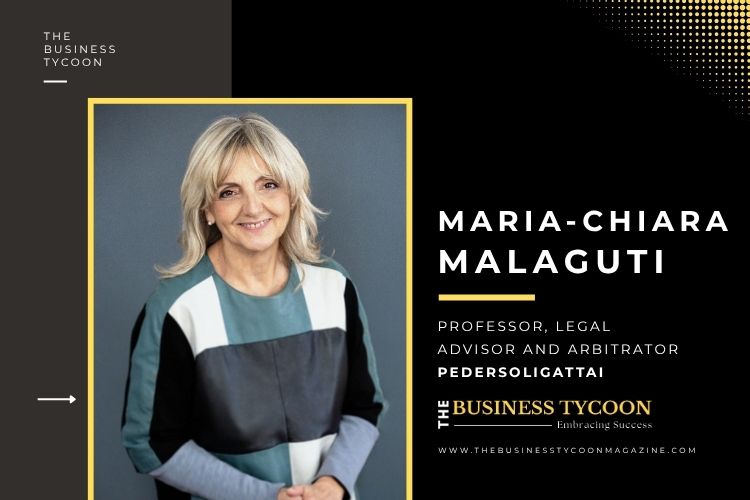
Maria-Chiara Malaguti: The Visionary Legal Trailblazer Shaping Global Governance Through Law, Leadership, and Intellectual Curiosity
In a world increasingly defined by geopolitical uncertainty, digital transformation, and rapidly evolving regulatory frameworks, the role of law has never been more essential, or more complex. Yet, while institutions shift and markets adapt, visionary legal leaders continue to bridge divides, shape governance, and create frameworks that influence societies far beyond borders. Among these distinguished changemakers stands Maria-Chiara Malaguti, a globally respected legal scholar, arbitrator, professor, counsel and international advisor whose remarkable career has become synonymous with intellectual rigor, institutional leadership, and global legal transformation.
Now serving as Of Counsel at PedersoliGattai, Malaguti has spent decades navigating some of the most intricate intersections of international and private law, governance, finance, and public institutions. From advising sovereign entities and multinational corporations to serving in prestigious institutions such as the European Court of Justice (ECJ), the European Central Bank (ECB), and the World Bank, her career reflects not only professional excellence but also an unwavering curiosity about how societies organize themselves through rules, institutions, and governance.
Yet what makes Malaguti’s story truly exceptional is not merely the impressive list of titles she has accumulated throughout her career. It is the philosophy that has guided her journey: a relentless intellectual curiosity and a willingness to embrace opportunities that transcend conventional legal boundaries.
A Career Inspired by Curiosity Rather Than Convention
Unlike many professionals who carefully map out their future careers, Maria-Chiara Malaguti’s path into law emerged organically from an enduring curiosity about systems, economics, and human governance.
Holding degrees in both law and economics, Malaguti developed a dual perspective early in her academic life, one that would later become one of her greatest professional advantages. Rather than limiting herself to a single legal niche, she immersed herself in multiple disciplines, beginning in commercial law and competition law before expanding into trade and investment law, financial markets law, and European Union law.
What followed was not a predetermined plan, but an extraordinary evolution shaped by intellectual exploration and professional courage.
Throughout her career, Malaguti moved seamlessly between private legal practice and influential public institutions, broadening her expertise while deepening her understanding of legal systems across jurisdictions. Her professional experiences took her from law firms to the European Court of Justice, from the European Central Bank to advisory roles for the Italian Ministry of Foreign Affairs, and eventually into innumerable missions with the World Bank, where she collaborated closely with central banks across the globe.
Having lived and worked across multiple cities and legal environments, Malaguti cultivated an invaluable global perspective, one rooted not merely in theory, but in lived institutional experience.
“The thread connecting everything,” she reflects, “was curiosity about the way people organize and govern their societies, and how rules shape markets, institutions, and people’s lives.”
This mindset would eventually position her as one of the leading voices in international legal governance and arbitration.
Leading at the Crossroads of Global Law and Governance
Today, Maria-Chiara Malaguti operates at the highest levels of international legal practice, serving as an arbitrator in complex disputes involving sovereign entities and multinational corporations. Her work often sits at the intersection of law, global institutions, finance, and governance, areas where legal precision and strategic insight become indispensable.
Her expertise spans international arbitration, transnational law, commercial and financial governance, and legal harmonization, fields that increasingly define the modern global legal landscape.
One of the most defining chapters of her career came through her role as President of UNIDROIT (International Institute for the Unification of Private Law), a globally influential intergovernmental organization dedicated to harmonizing and modernizing private and commercial law across jurisdictions.
In this role, Malaguti contributed significantly to developing legal frameworks governing cross-border transactions while fostering meaningful dialogue among diverse legal systems.
At a time when international markets are becoming increasingly interconnected yet politically fragmented, her work focused on building bridges, ensuring that legal systems with different traditions and priorities could still cooperate toward shared solutions.
Her current role as Of Counsel at PedersoliGattai, one of Italy’s largest and most respected independent law firms, further strengthens her global legal footprint. The position complements a career shaped across academia, arbitration, multilateral institutions, and cross-border advisory work.
Yet despite her extraordinary professional commitments, Malaguti remains deeply devoted to education.
As a professor and academic leader, she continues mentoring aspiring legal professionals, encouraging younger generations to approach law not merely as a profession but as an intellectual discipline that requires openness, adaptability, and international awareness.
Breaking Barriers in a Male-Dominated Legal World
Success, however, rarely arrives without challenges.
For Maria-Chiara Malaguti, the early stages of her legal career demanded resilience, preparation, and unwavering self-belief.
Entering fields such as competition law, finance, and arbitration during a period when women were significantly underrepresented, she frequently found herself as one of the few women in rooms dominated by older male professionals.
Rather than allowing these realities to limit her aspirations, she embraced preparation as her most powerful equalizer.
“Nobody hands you credibility,” she explains. “You build it case by case, argument by argument.”
Her journey was shaped not only by gender barriers but also by cultural and geographic challenges. Building an international legal career from Italy, particularly within traditionally male-dominated global legal circles, required persistence and confidence.
Instead of trying to conform to prevailing norms, Malaguti leaned into her strengths, embracing the richness of her civil law background and leveraging multilateral institutions as spaces where diverse legal cultures could engage on equal footing.
A lesson from her mother remained a quiet source of strength throughout her career: smile, remain resilient, and avoid bitterness or resentment.
This philosophy of quiet determination would later define her leadership style.
A Leadership Philosophy Rooted in Inclusion and Intellectual Diversity
For someone who has spent decades leading within international legal environments, Maria-Chiara Malaguti understands that effective leadership is not about authority alone, it is about creating meaningful collaboration across differences.
International legal teams often bring together professionals shaped by vastly different intellectual traditions, legal systems, and institutional experiences.
A litigator trained in New York, a French administrative lawyer, or a central bank economist from Sub-Saharan Africa may approach identical legal questions in entirely different ways.
Rather than viewing this diversity as a challenge, Malaguti sees it as one of the profession’s greatest strengths.
Her approach to leadership centers on setting clear objectives while fostering an environment where disagreement is welcomed and intellectual exchange is encouraged.
Listening, transparency, and thoughtful decision-making remain central to her management philosophy.
By creating space for different perspectives while maintaining clarity of direction, she has successfully led within some of the world’s most complex institutional environments.
The Future of Law in a Rapidly Changing World
Few legal professionals possess the interdisciplinary perspective required to understand how technology, economics, and governance are reshaping legal systems globally.
For Maria-Chiara Malaguti, the greatest challenges facing the legal profession today extend beyond legal doctrine.
She points to the fragmentation of the international legal order as one of the defining concerns of modern legal practice.
As multilateralism faces mounting pressure and geopolitical tensions reshape regulatory systems, international practitioners increasingly find themselves navigating competing frameworks.
At the same time, technological advancements, including artificial intelligence, digital assets, cybersecurity risks, and platform economies, are transforming traditional legal assumptions.
The legal frameworks inherited from earlier eras, Malaguti argues, were built for physical goods, national borders, and paper-based systems.
Today’s world no longer operates within those boundaries.
The real challenge lies not merely in digitizing existing legal processes, but in fundamentally rethinking concepts such as ownership, liability, consent, and institutional accountability.
With her background in both economics and law, Malaguti consistently evaluates innovation through a governance lens.
The question, she believes, is not simply what technology can accomplish, but what rules and institutions are needed to ensure technology serves humanity responsibly.
Championing Inclusion Beyond Words
While diversity and inclusion have become frequent talking points across industries, Maria-Chiara Malaguti believes meaningful progress requires action.
Throughout her career, she has actively mentored women and underrepresented professionals, advocated for more inclusive appointments in arbitration and institutional leadership, and used her influence to expand access to opportunities.
At PedersoliGattai, she continues supporting environments where younger legal professionals can grow, contribute, and feel represented.
Her perspective is clear: international law as well as transnational law cannot credibly claim to represent the world if those interpreting and shaping it come from narrowly defined backgrounds.
However, she also recognizes that genuine inclusion demands structural change.
Merit systems, appointment processes, and professional networks must evolve to create equitable pathways for emerging talent.
Her advocacy reflects not only professional responsibility but also lived experience.
Having personally navigated barriers as a woman in international legal spaces, she understands firsthand the importance of representation and access.
Mentorship as a Lasting Legacy
Ask Maria-Chiara Malaguti about her most meaningful professional contribution, and her answer extends beyond institutions and legal frameworks.
Yes, her work on harmonization and governance in international commercial and financial law, through organizations such as UNIDROIT and the World Bank, has left an undeniable mark.
But equally important, she says, are the people.
The students, young lawyers, and emerging professionals she has mentored throughout the years represent perhaps her most enduring legacy.
Many now hold influential positions across institutions, academia, and international legal practice.
Her belief is simple yet profound: true impact often reveals itself one generation later.
In an era where success is often measured by titles or visibility, Malaguti’s commitment to mentorship reflects a deeper understanding of leadership, one centered on continuity, empowerment, and intellectual generosity.
Advice for the Next Generation of International Lawyers
For young legal professionals aspiring to global careers, Maria-Chiara Malaguti offers guidance shaped by her own unconventional trajectory — and it begins, unsurprisingly, with curiosity. “Learn languages,” she urges. “Study economics, history, philosophy — not just law. Travel, but not just for vacation. Understand at least one legal system that is fundamentally different from your own. — It will change how you think about your own.” “Do not be in a hurry,” she advises. “My career made sense only in retrospect — competition law, financial markets, EU law, central banking, international arbitration — and each move taught me something the previous one could not.”
The international legal world, she observes, increasingly rewards professionals who can connect ideas across borders, disciplines, and systems — an ability that demands openness and intellectual range.
“The best lawyers,” she believes, “are interesting people, not simply technically skilled professionals.”
A Legacy Still Being Written
As the legal profession stands at the threshold of profound transformation, Maria-Chiara Malaguti remains optimistic.
Artificial intelligence will reshape legal research and drafting. Climate change will introduce entirely new areas of legal governance. Cross-border regulation will continue to evolve amid geopolitical complexity.
Yet amid uncertainty, one thing remains constant: the need for thoughtful legal minds capable of bridging differences and navigating complexity with wisdom.
Maria-Chiara Malaguti has spent her career doing precisely that.
Driven not by rigid plans but by curiosity, resilience, and an enduring commitment to intellectual growth, she has become a powerful force in shaping the future of international law.
Her story is not only one of legal excellence, it is a testament to visionary leadership, global impact, and the transformative power of curiosity.
And perhaps most inspiring of all, hers is a journey still unfolding.