
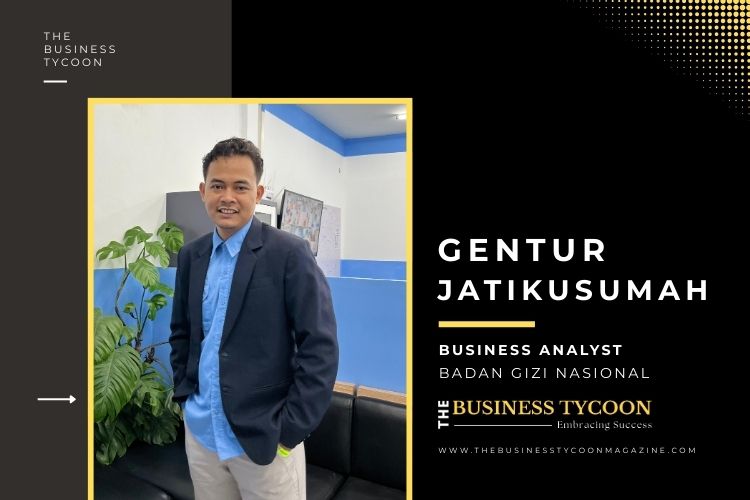
Gentur Jatikusumah: Nourishing a Nation with Data, Discipline, and Deep Humanity
Redefining Public Nutrition as a Strategic Investment in Indonesia’s Future
In a world where leadership is often measured by financial returns and market dominance, Gentur Jatikusumah stands at the helm of an organization where success is defined by healthier children, empowered mothers, and measurable progress in national well-being. As a Business Analyst at Badan Gizi Nasional’s nutrition fulfillment service unit, Gentur operates at the intersection of nutrition science, logistics, digital transformation, and public service, an ecosystem where every decision impacts the future of Indonesia.
This is not simply a story about food distribution. It is a story about systemic change. It is about transforming the perception of nutrition from a basic social service into a data-driven national investment. Under Gentur’s leadership and strategic contribution, the nutrition fulfillment unit has emerged as the operational backbone of public health nutrition, serving kindergarten to high school students, toddlers, nursing mothers, and pregnant women with scientifically formulated, hygienic, and carefully monitored meals.
From “Feeding” to “Nourishing”: A Mindset Revolution
One of the earliest and most significant challenges Gentur faced was not logistical; it was philosophical.
“When we began,” he reflects, “many stakeholders viewed nutritional fulfillment as simply feeding people.” But filling stomachs and nourishing bodies are two very different missions. One satisfies immediate hunger; the other builds cognitive capacity, strengthens immunity, and reduces long-term health risks.
Changing this mindset required rigorous advocacy and data-backed persuasion. Budget discussions often framed higher nutritional standards as additional costs. Gentur and his team reframed the narrative: improved nutrition is not expenditure, it is infrastructure for human capital.
By presenting measurable correlations between balanced meals and improved student concentration, reduced stunting rates, and enhanced community health outcomes, the organization redefined nutrition as an economic multiplier. In doing so, they elevated the conversation from catering logistics to national development strategy.
Building the Operational Backbone of Public Health
Unlike traditional catering businesses, the nutrition fulfillment service unit functions as the frontline of public health. It manages the entire ecosystem, from sourcing raw materials from local farmers to delivering hygienic, calorie-measured meals across diverse regions.
Here, profits are not calculated in margins. They are measured in:
- Health metrics improvements
- Reduced stunting statistics
- Increased cognitive focus in students
- Enhanced maternal health indicators
Gentur emphasizes that the unit works at the confluence of logistics precision, scientific formulation, and community engagement. Every meal box represents a calibrated blend of macronutrients and micronutrients, formulated to meet age-specific needs.
“Every calorie counts,” he says. And in Indonesia’s journey toward Indonesia Emas 2045, that philosophy is more than operational; it is patriotic.
The Digital Turning Point
The true inflection point in the organization’s growth came through digitization. Recognizing that trust is built on transparency, Gentur spearheaded the integration of advanced monitoring systems.
The team implemented:
- A digital dashboard to monitor food waste
- Sentiment analysis dashboards for agencies served
- Online AI-based nutrition consultations
- A body mass index (BMI) calculation application with nutritional solutions
- Real-time tracking of food distribution and feedback
The result was transformative. With verifiable data proving that 99% of food deliveries arrived on time and met strict calorie standards, the organization gained unprecedented trust from government stakeholders. Transparency became their strongest currency.
Digitization also aligned seamlessly with the national vision of Indonesia Emas 2045, accelerating operational expansion and positioning the unit as a benchmark for public-sector innovation.
Data Driven, People Centered
While Gentur’s leadership philosophy is firmly rooted in data, it never loses sight of humanity.
“Our consistency,” he explains, “is rooted in being data-driven. But behind every metric, there is a person.”
The organization’s sustained success rests on three foundational pillars:
Strict Quality Control. A zero-tolerance policy for hygiene negligence ensures safety standards are uncompromising.
Local Collaboration. By integrating local farmers and suppliers, the organization guarantees freshness while stimulating local economies.
Adaptability. Feedback from beneficiaries is actively incorporated. If a menu item is unpopular, it is revised without compromising nutritional value.
This responsiveness fosters sustainability and community acceptance. Nutrition programs are not imposed; they are embraced.
Leading with Empathetic Precision
In today’s high-pressure operational environments, leaders face mounting expectations for speed, perfection, and continuous delivery. Burnout, Gentur notes, is one of the most pressing challenges in public service leadership.
His strategy is what he calls “Empathetic Precision.”
Precision means clear standard operating procedures and automated workflows that reduce decision fatigue. When systems function efficiently, teams experience less stress.
Empathy, however, is the stabilizing force. Gentur ensures his team’s well-being remains a priority. Small victories are celebrated. Leadership presence extends beyond crisis management; he leads from the ground, alongside those delivering daily services.
“Serving those who serve others,” he says, “is the essence of sustainable leadership.”
This dual approach ensures morale remains strong even in environments defined by constant demand.
Innovation as a Collective Responsibility
Nutrition science evolves rapidly, and operational innovation must keep pace. To cultivate continuous learning, Gentur institutionalized what he calls “Saving Knowledge and Utilizing It.”
The organization regularly invites nutritionists, supply chain specialists, accountants, and food safety auditors to train staff. Knowledge is not centralized; it is democratized.
Some of the most effective efficiency improvements have originated from field drivers and kitchen supervisors. By fostering a “Safe to Fail” environment, team members are encouraged to propose new packaging systems, delivery routes, or preparation methods.
If an idea succeeds, it is scaled. If it fails, it becomes a lesson. This agile framework prevents minor inefficiencies from escalating into systemic issues.
Innovation, in Gentur’s ecosystem, is not a department; it is a culture.
Championing Diversity, Equity, and Inclusion
In the realm of food and nutrition, diversity is not theoretical; it is practical. Dietary habits vary across regions, cultures, and communities.
Gentur’s workforce reflects the communities they serve. Women’s empowerment is a central focus, with career advancement determined by training, performance, and dedication, not background.
Inclusion also shapes service delivery. Menus are tailored to respect local food wisdom while meeting scientific nutritional standards. Cultural sensitivity ensures programs are not only effective but accepted and valued.
By harmonizing modern science with traditional knowledge, the organization strengthens both health outcomes and social cohesion.
Nutritional Precision as a Product
Though beneficiaries receive meal boxes, Gentur describes the organization’s real product as “Nutritional Precision Guarantee.”
Its core services include:
- Mass Nutrition Provision: Daily balanced meals for schools, minors, pregnant and lactating women.
- Nutrition Consultation and Education: Programs explaining why specific foods are served.
- Nutrition Buddy: Digital tools offering BMI calculations and personalized nutritional solutions.
This layered approach ensures beneficiaries are not passive recipients. They become informed participants in their own health journey.
Technology as the Silent Partner
Technology underpins the entire operational model. Beneficiaries and supervisors can scan deliveries to instantly view menu compositions and nutritional breakdowns. Internally, data analytics enable demand forecasting, minimizing food waste, and optimizing resource allocation.
Waste reduction is both an economic and environmental priority. By predicting consumption patterns, the organization directs savings back into quality enhancement rather than covering inefficiencies.
Technology does not replace human oversight; it amplifies it.
Disrupting Traditional Systems
Public nutrition services have historically been hindered by a transactional “seller and buyer” dynamic. Orders were placed; the cheapest food was delivered.
Gentur disrupted this paradigm by embedding nutritionists directly into procurement and operational chains. This eliminated intermediary compromises and raised industry standards.
The guiding question shifted from “Are stomachs full?” to “Are nutritional needs met?”
This recalibration forced local supply chains to upgrade quality and compliance to meet stricter standards, elevating the entire ecosystem.
Scaling Through Hyper-Localization
A recent expansion into remote and underserved areas demonstrates Gentur’s strategic agility.
Rather than imposing centralized menus, the team collaborated with local leaders to design hyper-localized meal plans using regional ingredients, prepared under modern safety standards.
The results were compelling:
- Logistics costs reduced significantly
- Acceptance rates increased by 40%
- Community ownership strengthened
This model proves that scalability in public nutrition does not require uniformity. It requires respect.
Staying Competitive Like a Startup
Despite operating within a public framework, Gentur treats service units like technology startups. A/B testing on menus, regular satisfaction surveys, and strategic partnerships with village cooperatives keep the organization adaptive.
By sourcing locally, they insulate operations from global supply chain disruptions while strengthening regional economies. Continuous research partnerships ensure access to innovations in food fortification and safe preservation methods.
Agility, in Gentur’s model, is institutionalized.
Nourishing the Future of Indonesia
At its core, Gentur Jatikusumah’s work is about safeguarding the nation’s future. Balanced nutrition today shapes cognitive performance tomorrow. Stronger maternal health builds resilient communities. Reduced waste preserves environmental integrity.
Through disciplined systems, technological integration, empathetic leadership, and unwavering commitment to quality, he has transformed public nutrition from a logistical service into a strategic pillar of national development.
In a world often captivated by rapid financial gains and disruptive technologies, Gentur reminds us that the most powerful transformation may be the quietest: a carefully measured meal, delivered on time, nourishing both body and potential.
For Indonesia, that is not just service. It is a legacy.